
CHARLOTTE, N.C. -- North Carolina regulators say Duke Energy illegally pumped 61 million gallons of contaminated water from a coal ash pit into the Cape Fear River, marking the eighth time in less than a month the nation's largest electricity company has been cited for environmental violations.Any negative attention Duke gets from this is important, mainly because it is likely the only meaningful consequence they will face for what they've done. Just like the banks and so many other major corporations, they do these things knowing they will eventually get caught and eventually have to pay some minor fine that is way cheaper than not breaking the law.
The pumping violated the terms of Duke's wastewater permit at its Cape Fear Plant, State Department of Environment and Natural Resources spokesman Jamie Kritzer said Thursday. Kritzer said the agency has issued Duke a formal notice of violation, which could result in hefty fines.
Regulators from the agency said the illegal pumping had been going on for months. It wasn't immediately clear if Duke's efforts to empty the pond were related to a crack in the earthen dam holding back the coal ash. Duke first disclosed the existence of the crack to regulators on Thursday.
Inspectors are trying to determine the cause of the crack, but the dike does not appear to be in imminent danger of collapse, said State Dam Safety Engineer Steve McEvoy.
Duke did not respond Thursday to requests for comment from The Associated Press.
A Feb. 2 pipe collapse at a similar Duke coal ash dump in Eden coated 70 miles of the Dan River with toxic sludge. Duke has nearly three dozen other ash pits spread out at 14 coal-fired power plants across the state.
Showing posts with label Environment. Show all posts
Showing posts with label Environment. Show all posts
Monday, March 24, 2014
Duke Energy Caught Dumping Million Gallons Of Contaminated Water into River
Well this is just great:

Tuesday, March 18, 2014
The Price of Solar Panels is Plummeting
This is obviously very good news:
 The rest of this article is pretty interesting, discussing the possibility that it might mean people go off the grid in the long run and are no longer dependent on awful utility companies. Let's hope so!
Friday, August 23, 2013
Fukushima Isn't Getting Any Less Permanently Ruined
Yikes:
Basically water levels have been lowering in these tanks for some time and it's not hard to figure out the contaminated water went. It's also a reminder about the scope and time horizon on these environmental disasters. I will be seeing reports on Fukushima for the rest of my life. Yellow tailed tuna won't spawn in the gulf of mexico for 30 years. Being hyperbolic about the damage these disasters have caused doesn't really do them justice.
A nuclear expert has told the BBC that he believes the current water leaks at Fukushima are much worse than the authorities have stated.The whole article is terrifying and worth reading if you have the time.
Mycle Schneider is an independent consultant who has previously advised the French and German governments.
He says water is leaking out all over the site and there are no accurate figures for radiation levels.
Meanwhile the chairman of Japan's nuclear authority said that he feared there would be further leaks.
The ongoing problems at the Fukushima plant increased in recent days when the Tokyo Electric Power Company (Tepco) admitted that around 300 tonnes of highly radioactive water had leaked from a storage tank on the site.
Basically water levels have been lowering in these tanks for some time and it's not hard to figure out the contaminated water went. It's also a reminder about the scope and time horizon on these environmental disasters. I will be seeing reports on Fukushima for the rest of my life. Yellow tailed tuna won't spawn in the gulf of mexico for 30 years. Being hyperbolic about the damage these disasters have caused doesn't really do them justice.
Tuesday, April 2, 2013
Heavy Crude Pipeline Explodes in Arkansas
There aren't really words for the horrifying sights in this video.
My only hope is that this can help generate momentum against the Keystone XL pipeline, and encourage more activism that forces Obama to reverse course and oppose it. The more people who see the video, the better. Pass it around.
My only hope is that this can help generate momentum against the Keystone XL pipeline, and encourage more activism that forces Obama to reverse course and oppose it. The more people who see the video, the better. Pass it around.
Wednesday, February 20, 2013
Obama Considering Pro Fracking Dept of Energy Head
Not exciting.
Feb 6 (Reuters) - President Barack Obama is considering naming nuclear physicist Ernest Moniz, who is one of his science and energy advisers, as the next energy secretary, sources familiar with the matter told Reuters on Wednesday.Fighting climate change by polluting our groundwater and tripling down on something that may have even worse environmental effects that we have no clue about. Awesome!
Moniz, who was undersecretary at the Energy Department during the Clinton administration, is a familiar figure on Capitol Hill, where he has often talked to lawmakers about how abundant supplies of U.S. natural gas will gradually replace coal as a source of electricity.
Thursday, January 10, 2013

Friday, November 30, 2012
The Truth About Fracking
One of the things that drove me absolutely nuts during the election was both Obama and Romney falling over themselves to prove how much they support and love fracking. It's an absolute disaster, and please watch this really well done video on the subject:
I wanted to add D's comment to the post cause I thought it did a really good job of describing the overarching problem here about what the right has done with science in our public discourse: (emphasis added is mine)
I wanted to add D's comment to the post cause I thought it did a really good job of describing the overarching problem here about what the right has done with science in our public discourse: (emphasis added is mine)
This is all incredibly depressing. It's become too easy to dismiss years of scientific research by creating a "controversy." The real irony of it all is that opponents of science can play off the scientific process, which in and of itself is about controversy. The scientific method with its dependency on repetition and the peer review process that encourages critical assessment of alternative explanations both facilitate this "debate" idea even in cases where the evidence is overwhelming in favor of one viewpoint (see Evolution for an excellent case study). The fact that the science education is this country is slightly better than awful also compounds the issue because the general public can't think critically about scientific alternatives and journalists are afraid to take sides or think critically because they don't want to be labeled as biased or even worse, LIBERAL.A reason having this blog is awesome: Having crazy smart actual scientists like Jaypop, D, Nick F. and others being able to read and chime in regularly.
So, as I said at the beginning, the state of science and policy is depressing and disheartening. All too often it takes a catastrophe to destroy the public's apathy or disillusionment with these issues.
Friday, July 6, 2012

Monday, April 23, 2012
Shell Spill 60 Times Bigger than Initially Reported
During our own fun oil spill, not enough of a point was made that while this was fucking terrible, this is something oil companies have been getting away with all around the world with pretty much no media attention. Part of the "getting away with it" is usually making up numbers to make the spill seem less significant.
That was the case here, although it took about a month for video to get released and for non hacks to produce real estimates of what we were doing to the gulf. Shell's spill in Nigeria received almost no media coverage, and people are just now piecing together the scope of this atrocity. Firedoglake:
That was the case here, although it took about a month for video to get released and for non hacks to produce real estimates of what we were doing to the gulf. Shell's spill in Nigeria received almost no media coverage, and people are just now piecing together the scope of this atrocity. Firedoglake:
The two NGOs unveiled documents pertaining to the Royal Dutch Shell Oil 2008 Bodo oil pipeline spill that showed that 60 times the amount of oil Shell had originally reported spilling have actually spilled in the ravaged Niger Delta coastal townwith a population of 60,000 people.It may sound bad, but I'm pretty sure this isn't a problem that more drilling can't solve!
In a press release, Amnesty explained its findings:Adding insult to injury, Shell has yet to do a damn thing about it. “More than three years after the Bodo oil spill, Shell has yet to conduct a proper clean up or to pay any official compensation to the affected communities,” wrote Amnesty.
The previously unpublished assessment, carried out by US firm Accufacts, found that between 1,440 and 4,320 barrels of oil were flooding the Bodo area each day following the leak. The Nigerian regulators have confirmed that the spill lasted for 72 days.
Shell’s official investigation report claims only 1,640 barrels of oil were spilt in total. But based on the independent assessment the total amount of oil spilt over the 72 day period is between 103,000 barrels and 311,000 barrels.
Monday, October 17, 2011
BP Regains Bidding Rights For Gulf Drilling
Remember those guys that did such a great job drilling in the gulf last time?
Let's give em another shot!
So let's obviously keep doing it, and why not let the same people who fucked it up last time go for it again? Awesome.
Let's give em another shot!
The Obama administration has infuriated environmentalists by giving BP the green light to bid for new drilling rights in the Gulf of Mexico.The "they don't have a deeply flawed record" quote is jaw dropping, but the statement from friends of the earth really hits the nail on the head. BP's non-reaction to the gulf spill was essentially the airing of a dirty secret that no one has the slightest clue what to do when something goes wrong with one of these things.
The move – seen as a major step in the company's political rehabilitation as an offshore driller following the Deepwater Horizon accident – was revealed by the head of the US safety regulator after a congressional hearing in Washington.
"They don't have a deeply flawed record offshore," said Michael Bromwich, head of the newly formed Bureau of Safety and Environmental Enforcement. "The question is: 'Do you administer the administrative death penalty based on one incident?', and we have concluded that's not appropriate."
Drilling rights are sold off on a regular basis but many believed BP would be ruled out as unsuitable after the gulf well blowout that killed 11 workers and polluted the beaches of southern states. The next sale comes up in December, when more than 8m hectares (20m acres) of offshore rights will come up for grabs.
BP declined to comment, but Friends of the Earth said it was appalled. "Governments should be administering the death penalty to all deepwater drilling rather than waiting for yet more devastating incidents like the Deepwater Horizon in the Gulf of Mexico or in any other part of the world," argued Craig Bennett, director of policy and campaigns at the environmental group.
"It is not just BP operations that are deeply flawed," he added. "There is not a single oil company that can say with a high degree of confidence that it can drill safely and how it will clear up if something goes wrong. It is clear in the context of climate change we need to develop new clean technologies, not hunt for fossil fuels in ever more remote and hard-to-reach areas."
So let's obviously keep doing it, and why not let the same people who fucked it up last time go for it again? Awesome.
Monday, September 12, 2011
Energy Subsidies: What If?
A pretty cool graphic via Roger Ebert's blog:

This is a good response to the usual knocks against solar energy from conservatives. Despite all the doom and gloom rehtoric, a greener country is possible! It would just take the government deciding they no long want to prop up energy sources that are killing us and our planet, and put that money into energy sources that won't kill us.
With the political power of the oil/gas/coal industries this isn't an easy task, but it's not as if there's some permanent bond we have with dirty energy that can't be overcome.
Sunday, September 4, 2011
Clean Air is For Suckers
This is fucking shameful: (Brad Plumer On Ezra Klein's blog)
Absolutely disgusting.
On Friday, in a surprise move, the White House told the EPA to pull back on national standards for ground-level ozone pollution — smog — which the agency has been working on for the past two years. My colleague Juliet Eilperin has the full story, but the upshot is that this represents a clear victory for business groups and Republicans, who had been lobbying to postpone the regulations until a new scheduled review in 2013.At the surface, this move is typical. Obama caving to conservatives on a no brainer issue in exchange for a political advantage to be named later. So just how bad is this?
To add a bit to this, though, it’s worth taking a closer look at why environmentalists and clean-air advocates are so furious right now. Groups that have been lobbying for the long-delayed ozone update say they were essentially betrayed by the Obama administration, which, back in 2009, had fended off a lawsuit over Bush-era ozone rules by promising to issue tougher new standards. That, obviously, isn’t going to happen now. What’s more, critics note, the White House’s stated reasons for yanking the rules make no sense at all.
First, some context. Under the Clean Air Act, the EPA is required to conduct a review of national standards on industrial smog every five years. Ground-level ozone is formed when emissions from power plants, vehicles and factories reacts with sunlight. The resulting pollution can, as the EPA explains, “trigger a variety of health problems including chest pain, coughing, throat irritation, and congestion. It can worsen bronchitis, emphysema, and asthma.”That's really fucking bad. And the Administration had 100% control over this issue themselves, with no congressional approval needed, to tea party standing in their way. And they send us back All to score political points that no one gives a fuck about.
The last time new ozone standards were set was back in 1997 — at 84 parts per billion. In 2006, the EPA reviewed the science on ozone and health, which had advanced considerably over the years: It wasn’t until the 2000s, for instance, that researchers realized ground-level ozone might actually be killing people, not just causing respiratory problems. Realizing that the old standards were woefully out of date, EPA scientists recommended a new level of 60 to 70 parts per billion. The Bush administration, however, decided to go with a less-stringent level of 75 parts per billion in its final rules, issued in 2008.
Groups such as the American Lung Association quickly filed a lawsuit to stop the Bush rules, which they claimed were too weak and would lead to thousands of unnecessary deaths and cases of respiratory disease. After Obama got elected, however, the new EPA said it basically agreed with the critics and would issue stronger rules by August 2010. At that point, the ALA agreed to hold off on its lawsuit. “We said, that sounds reasonable to us,” says Paul Billings, the ALA’s vice-president for policy and advocacy. “We basically trusted their intentions.”
But August 2010 rolled around. Still no rules. The EPA asked for a further extension. Then October. Then December. Still nothing. Then the EPA said it wanted to go back and look at the science again, just to double-check. Sure enough, EPA’s scientific review board said that a standard of 60 to 70 parts per billion was the most cost-effective way to protect public health. And EPA administrator Lisa Jackson announced that the final rules would be in line with the science.
Industry groups, obviously, weren’t pleased with this. They noted that complying with a stricter standard could cost them anywhere from $19 billion to $90 billion per year by 2020. (The EPA did, however, note that a tougher standard would yield benefits of $13 billion to $100 billion, and that the benefits would outweigh the costs.) Republican House Majority Leader Eric Cantor dubbed the ozone proposal “possibly the most harmful of all the currently anticipated Obama administration regulations.”
So now, today, the White House announced that it’s not going to have any new rules. On a call with reporters, White House officials argued that it doesn’t make sense to put out new rules in 2011 when there’s going to be another scheduled review of the ozone science in 2013.
But critics say that this reasoning is flawed. For one, notes Amy Royden-Bloom of the National Association of Clean Air Agencies, if the EPA did issue a new ozone standard this year, then it could always just postpone its next scientific review until 2016, in line with the law. Second, notes Frank O’Donnell of Clean Air Watch, there’s no reason to think that a brand-new ozone standard will actually be issued by 2013.
That’s just when the scientific review is due. Crafting new rules will take longer than that, given the inevitable delays and lawsuits. “I’d say three years, minimum,” says O’Donnell. (When I asked White House officials about this, they said they weren’t sure how long it would take.) And third, says Paul Billings of the ALA, it’s not clear that the science on ozone and human health will change dramatically between now and 2013 — if anything, the case for regulating ozone is likely to get stronger.
Absolutely disgusting.
Tuesday, July 19, 2011
Exxon Trying To Reclaim Worst Oil Company Title
The lack of coverage that this has received in the media is rather stunning. (and admittedly here as well, been meaning to put something up about this for a week or two now):
It should be noted that with the environmental disasters we've had in the last year, Republicans are actively trying to destroy the EPA:
They must be feeling some sort of real heat on this issue, because they have the urge to at least pretend like they're caring:
And while I appreciate the idea of more inspectors and higher penalties... the House GOP is attempting to DEFUND THE EPA with their next budget.
You know when a few more inspectors and higher fines won't do the trick? When you're simultaneously trying to defund the division that would employ those inspectors and hand out those fines. It's a tried and true Republican tactic seen with the EPA and Department of Labor during the Bush years, and it's unfortunately fairly successful. People generally think the EPA and OSHA are good things and don't want them destroyed, so rather than actually trying to take them away, you just don't fund them, and hire industry shills to run those departments. It's much easier to do, and then this happens:
 It's important to understand the link between the policies and their results. If you don't fund OSHA, it has consequences. One group of people in DC (largely) thinks the EPA shouldn't exist. The other group (mostly) disagrees, and thinks it should exist.
This is a pretty big difference, and is a message we should be spreading to as many people as possible.
An oil spill in Montana's Yellowstone River surged toward North Dakota on Sunday as outraged residents demanded more government oversight of Exxon Mobil's cleanup.But wait, there's more! Yesterday:
An estimated 750 to 1,000 barrels, or up to 42,000 gallons, spilled through a damaged pipeline in the riverbed, Exxon spokesman Alan Jeffers said. The break near Billings could be related to the river's high water level, officials said.
More than 120 people were working on the cleanup late Sunday, Jeffers said. But local officials said because of the raging floodwaters, only a handful of crews were laying absorbent pads and booms to trap the oil along short stretches of the river between Billings and Laurel. In some areas, residents said, oil may be flowing underneath the booms and continuing downstream in the murky water.
Jeffers said most of the oil was believed to be within 10 miles of the spill site, and Exxon crews were flying over the area late Sunday to assess how far it had spread since the Friday night spill.
But Montana's governor disputed the 10-mile estimate.
"Nobody can say definitively," Gov. Brian Schweitzer said. "It's too early. We need boats on the water," not just flyovers. Because of the high water, however, boats were potentially unsafe.
There were reports of oil as far as 100 miles away near the town of Hysham, Yellowstone County Commissioner Bill Kennedy said.
Although the spill is downstream from Yellowstone National Park and the fertile Yellowstone fly-fishing grounds, some officials worried it could harm the tourism industry, which draws 11 million visitors a year to a state with a population of just 980,000.
"We take our rivers very seriously here in Montana," said Schweitzer, a soil scientist who planned to visit the spill site Tuesday. "We will not allow this catastrophe to affect the $400-million trout industry in Montana."
Schweitzer, a Democrat, said the U.S. Environmental Protection Agency had been working with state agencies to investigate the cause of the spill and would test air, water and soil samples. Exxon will be expected to pay for the cleanup so that "everybody along that river is made whole," he said.
HELENA, Mont. (AP) — A new oil spill involving hundreds of gallons of crude has been discovered in Montana 350 miles from where cleanup crews are mopping up a larger one on the Yellowstone River.These obviously aren't as large as the Gulf spill, but you'd think the fact that it occurred in such a well known area would have garnered more attention. Also, it seems Exxon learned from BP that lying about literally every aspect of the spill for months is a pretty bad PR strategy.
The amount spilled at the FX Drilling Co. oil field in a remote corner of the Blackfeet Indian Reservation appears to be much less than the estimated 42,000 gallons that emptied into the Yellowstone River earlier this month. But the northwestern Montana spill comes at a time when all pipeline and oil operations in the state are under scrutiny as a result of the larger Exxon Mobil Corp. pipeline break.
Andy Pierce, vice president of FX Energy Inc., the Salt Lake-based parent company of FX Drilling, estimated that between 10 to 15 barrels, or 420 to 630 gallons, leaked from a broken line as a result of the earth shifting during flooding in the area.
Indian Country Environmental Associates, the organization heading the cleanup, put the amount between 15 and 20 barrels, or up to 840 gallons.
The broken flow line between two oil wells may have been leaking for 10 to 14 days before a neighboring landowner reported it last Tuesday.
It should be noted that with the environmental disasters we've had in the last year, Republicans are actively trying to destroy the EPA:
Republicans eager to undo regulatory burdens they say are hindering economic growth have advanced a series of proposals designed to rein in the power of the Environmental Protection Agency and other federal agencies.Credit to the Houston Chronicle for running with the "Yellowstone spill puts Republicans in tough spot" headline, which is far more confrontational than the usual "Republicans say Destroying the EPA will Lead to Less Spills, Some Disagree" headline that the beltway media churns out on a daily basis.
They have taken aim at the EPA’s power to regulate greenhouse gas emissions, pollution from offshore drilling projects in the Arctic and ash from coal-fired power plants. And Republicans in control of the House just advanced a federal spending bill that would place other limits on the EPA and Interior Department’s power to regulate.
But the July 1 oil spill from an Exxon Mobil pipeline in Montana and a series of other pipeline accidents may be changing that dynamic. House Republicans are feeling new pressure to abandon their strategy, at least when it comes to federal oversight of pipeline safety.
They must be feeling some sort of real heat on this issue, because they have the urge to at least pretend like they're caring:
At the same time, the Yellowstone River spill also is putting Republicans in a politically tricky position advancing a top priority: legislation that would force the Obama administration to soon decide whether it will approve the proposed Keystone XL pipeline to carry oil sands from Alberta, Canada, to Gulf Coast refineries.This all sounds positive, but there have been two pipeline spills in the last month (where no one is really sure of the cause), and his priority seems to be pushing this bill through so that his committee can go back to their usual business, approving another pipeline expansion.
Rep. Fred Upton, R-Mich., the head of the House Energy and Commerce Committee — and one of the EPA’s leading congressional antagonists — has pledged to swiftly move new safety legislation this year. Under Upton’s watch, the panel is developing legislation that would boost civil penalties for pipeline spills and force federal regulators to reassess whether existing standards are good enough.
That measure dovetails with a bill advanced by a Senate committee in May that would boost existing civil fines for violating pipeline regulations and would create new penalties for violations that cause medical injuries or damage to the environment. The Senate bill also would authorize more federal safety inspectors.
Although pipelines are chiefly regulated by the Pipeline and Hazardous Material Safety Administration, the EPA takes a lead role in assessing public health and environmental damages from any spill.
And while I appreciate the idea of more inspectors and higher penalties... the House GOP is attempting to DEFUND THE EPA with their next budget.
You know when a few more inspectors and higher fines won't do the trick? When you're simultaneously trying to defund the division that would employ those inspectors and hand out those fines. It's a tried and true Republican tactic seen with the EPA and Department of Labor during the Bush years, and it's unfortunately fairly successful. People generally think the EPA and OSHA are good things and don't want them destroyed, so rather than actually trying to take them away, you just don't fund them, and hire industry shills to run those departments. It's much easier to do, and then this happens:
This is a pretty big difference, and is a message we should be spreading to as many people as possible.
Thursday, January 13, 2011
Score One For The EPA
This is a big fucking deal:
In nearly four decades since the Clean Water Act was passed, the Environmental Protection Agency has never vetoed any mining permit retroactively. That changed this morning.A huge step by Obama's EPA. Well done.
Word is just coming down via Coal Tattoo that the Obama administration EPA has just vetoed the largest single mountaintop removal permit in West Virginia history. The permit was initially awarded during the previous very fossil-friendly Bush administration, after a fractious decades-long court battle.
By retracting the Clean Water Air permit for Arch Coal’s 2,300-acre mine proposed for the Blair area of Logan County, West Virginia, the EPA is effectively suspending most major activity.
The decision comes after it reviewed more than 50,000 public comments and held a major public hearing in West Virginia, and is part of the Obama administration EPA crackdown on mountaintop removal.
EPA officials this morning were alerting West Virginia’s congressional delegation to their action, and undoubtedly preparing for a huge backlash from the mining industry and its friends among coalfield political leaders, including new "Democratic" Senator Joe Manchin, an EPA foe.
Friday, April 30, 2010
Gulf Oil Spill Goes From Bad to Worse
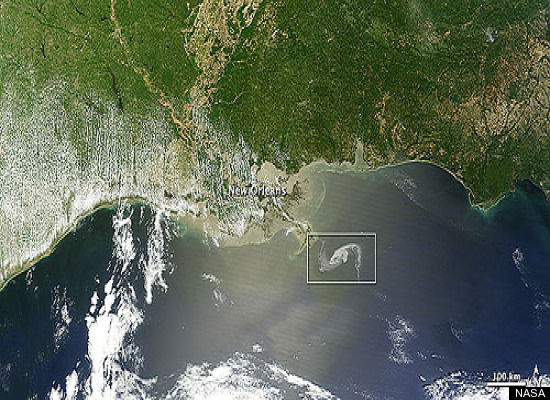
An absolute disaster:
VENICE, La. (AP) -- An oil spill that threatened to eclipse even the Exxon Valdez disaster spread out of control with a faint sheen washing ashore along the Gulf Coast Thursday night as fishermen rushed to scoop up shrimp and crews spread floating barriers around marshes.It looks like there's at least been one positive development, Obama is trying to walk back the stupid:
The spill was bigger than imagined -- five times more than first estimated -- and closer. Faint fingers of oily sheen were reaching the Mississippi River delta, lapping the Louisiana shoreline in long, thin lines.
"It is of grave concern," David Kennedy of the National Oceanic and Atmospheric Administration, told The Associated Press. "I am frightened. This is a very, very big thing. And the efforts that are going to be required to do anything about it, especially if it continues on, are just mind-boggling."
The oil slick could become the nation's worst environmental disaster in decades, threatening hundreds of species of fish, birds and other wildlife along the Gulf Coast, one of the world's richest seafood grounds, teeming with shrimp, oysters and other marine life. Thicker oil was in waters south and east of the Mississippi delta about five miles offshore.. . .Government officials said the blown-out well 40 miles offshore is spewing five times as much oil into the water as originally estimated – about 5,000 barrels, or 200,000 gallons, a day.
At that rate, the spill could eclipse the worst oil spill in U.S. history – the 11 million gallons that leaked from the grounded tanker Exxon Valdez in Alaska's Prince William Sound in 1989 – in the three months it could take to drill a relief well and plug the gushing well 5,000 feet underwater on the sea floor.
The White House put a hold on any new offshore oil projects until the rig disaster that caused the spill is explained.Just think, it was only a few short weeks ago, Obama ended all debates over the safety of offshore drilling forever, because he's so trans-formative and post partisan he can do that sort of thing:
A top adviser to President Barack Obama said Friday that no new oil drilling would be allowed until authorities learn what caused the explosion of the rig Deepwater Horizon. David Axelrod told ABC's "Good Morning America" that "no additional drilling has been authorized and none will until we find out what has happened here." Obama recently lifted a drilling moratorium for many offshore areas, including the Atlantic and Gulf areas.
Ultimately, we need to move beyond the tired debates between right and left, between business leaders and environmentalists, between those who would claim drilling is a cure all and those who would claim it has no place. Because this issue is just too important to allow our progress to languish while we fight the same old battles over and over again.Yeah those crazy people who thought it that offshore drilling had no place, what a bunch of pussies. Just think of the 5,000 barrels of progress that's being unleashed each day into the Gulf, couldn't let that chance slip by while we fight the same old battles.
Don't get me wrong, I'm thrilled that he's putting his plans on hold now that his triangulation has become politically toxic. It just infuriates me that it took one of the worst environmental disasters in our history to stop something that very well would have destroyed another coastline 10-20 years down the road had gone through.
The stupidity of this decision is one thing, but when it's combined with triangulation rhetoric it's enough to drive you mad.
The phrase "age old debates between right and left" is something that I've absolutely loathed about Obama (going all the way back to the primaries) and it doesn't get any easier now. His triangulation fetish is honestly deeper than what Clinton did, in that it really envelopes every one of his policy arguments.
I really don't know what Obama's motivations are when he uses that type of rhetoric in almost every speech he makes on just about every single subject. I'm actually trying to think of a topic that he's tackled where he hasn't taken on as president where he hasn't tried to position himself as this arbiter between "the extremes on either side" and can't think of one with the possible exception of his policy on Israel. Triangulation isn't merely a political tactic like it was under Clinton, it has become the ethos of the Obama Administration.
Maybe it's out of anger over how much this spill is going to wreak havoc on an already bombed out Mississippi delta, but I really hope he feels it for this decision, and hard. I hope the press plays back that idiotic speech over and over again, line by line, until he suffers some real political damage for it. Very rarely does a dangerous long term decision like the one he made come face to face with very serious negative consequences the country is about to face the short term. If he pays a price in the short term, there's at least a chance that it makes him think twice before doing something that blindingly stupid again in the future.
I still have real hopes for this Administration, and there's a never ending list of things that we need to accomplish. But actions as reckless as his should have consequences. It's gonna be too late to save us from this disaster, but hopefully it will save us the time of having another "age old left-right debate" about the environmental impact of offshore drilling in the future.
Wednesday, April 28, 2010
Spill Baby, Spill
Two weeks ago, the big oil companies must have thought they'd hit the lottery. They had a popular Democratic President willing to do betray his own supporters/promises/logic on an expansion of offshore drilling more radical than anything proposed under George W. Bush.
And then this happened:
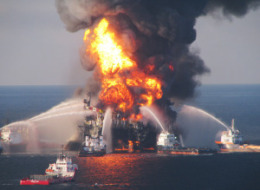
 I'm so glad we've moved past the age old debates between businesses leaders and environmentalists enough to realize that more offshore drilling is awesome and should be embraced by everyone.
This is horrific, and we can only hope that this disaster can make the Administration rethink it's idiotic reversal. Once again, we need to bring up the fact that this concession was not made with anything meaningful in return, but it was done solely to show Republicans that the Administration was willing to compromise.
As DCJonesy and I were discussing last night, there is not a single example of this type of preemptive concession leading to progress on anything that the Democrats are trying to push. They don't meet you half way, they don't vote yes. They take your concession, continue to lie about the bill and attempt to block it's passage.
Every day that this story remains in the news (and it's gonna be a while), it will be a huge black eye for the administration. And the beating that they (hopefully) take on this will be well deserved.
Attempting to enact idiotic policies rarely results in instant negative consequences for those that proposed them, but that might be the only positive to take from this environmental catastrophe.
And then this happened:
NEW ORLEANS — A deepwater oil platform that burned for more than a day after a massive explosion sank into the Gulf of Mexico on Thursday, creating the potential for a major spill as it underscored the slim chances that the 11 workers still missing survived.And this:
The sinking of the Deepwater Horizon, which burned violently until the gulf itself extinguished the fire, could unleash more than 300,000 of gallons of crude a day into the water. The environmental hazards would be greatest if the spill were to reach the Louisiana coast, some 50 miles away.
As efforts failed Tuesday to contain the flow of tens of thousands of gallons of oil leaking from an exploded well deep in the Gulf of Mexico, emergency response teams are considering a controlled burn-off of the oil on the water's surface as early as today.
Tuesday night, the expanding oil slick was about 20 miles off the coast of Louisiana and stretched 100 miles wide by 45 miles long at its greatest expanse.Workers were girding to protect environmentally sensitive areas nearby in the Mississippi River delta that are home to migratory birds and a nursery for nearly a quarter of the seafood production in the continental United States.
"It is the closest it's been to shore throughout this response, and we're paying attention to that, very careful attention to that," said U.S. Coast Guard Rear Adm. Mary Landry. She added that if the spill isn't contained, it has the potential to become "one of the most significant oil spills in U.S. history."
I'm so glad we've moved past the age old debates between businesses leaders and environmentalists enough to realize that more offshore drilling is awesome and should be embraced by everyone.This is horrific, and we can only hope that this disaster can make the Administration rethink it's idiotic reversal. Once again, we need to bring up the fact that this concession was not made with anything meaningful in return, but it was done solely to show Republicans that the Administration was willing to compromise.
As DCJonesy and I were discussing last night, there is not a single example of this type of preemptive concession leading to progress on anything that the Democrats are trying to push. They don't meet you half way, they don't vote yes. They take your concession, continue to lie about the bill and attempt to block it's passage.
Every day that this story remains in the news (and it's gonna be a while), it will be a huge black eye for the administration. And the beating that they (hopefully) take on this will be well deserved.
Attempting to enact idiotic policies rarely results in instant negative consequences for those that proposed them, but that might be the only positive to take from this environmental catastrophe.
Thursday, April 1, 2010
Drill Baby Drill (Obama Edition)

Not April Fools:
WASHINGTON — The Obama administration is proposing to open vast expanses of water along the Atlantic coastline, the eastern Gulf of Mexico and the north coast of Alaska to oil and natural gas drilling, much of it for the first time, officials said Tuesday.Offshore drilling, not really what you expect your Democratic president to be actively pursuing. I was under no illusions that Obama was going to be any kind of progressive when we elected him to office, but I didn't expect to be fighting him on shit like this.
The proposal — a compromise that will please oil companies and domestic drilling advocates but anger some residents of affected states and many environmental organizations — would end a longstanding moratorium on oil exploration along the East Coast from the northern tip of Delaware to the central coast of Florida, covering 167 million acres of ocean.
But while Mr. Obama has staked out middle ground on other environmental matters — supporting nuclear power, for example — the sheer breadth of the offshore drilling decision will take some of his supporters aback. And it is no sure thing that it will win support for a climate bill from undecided senators close to the oil industry, like Lisa Murkowski, Republican of Alaska, or Mary L. Landrieu, Democrat of Louisiana.
The Senate is expected to take up a climate bill in the next few weeks — the last chance to enact such legislation before midterm election concerns take over. Mr. Obama and his allies in the Senate have already made significant concessions on coal and nuclear power to try to win votes from Republicans and moderate Democrats. The new plan now grants one of the biggest items on the oil industry’s wish list — access to vast areas of the Outer Continental Shelf for drilling.
But even as Mr. Obama curries favors with pro-drilling interests, he risks a backlash from some coastal governors, senators and environmental advocates, who say that the relatively small amounts of oil to be gained in the offshore areas are not worth the environmental risks.
The Obama administration’s plan adopts some drilling proposals floated by President George W. Bush near the end of his tenure, including opening much of the Atlantic and Arctic Coasts. Those proposals were challenged in court on environmental grounds and set aside by President Obama shortly after he took office.
 Maryland, Delaware... well at least it isn't close to home. Let the oil companies poke around and see if they find anything, cause if there's anything they've taught us over the years it's that accidents never happen. I'm sure already cash strapped efforts that have fought so hard to preserve the Chesapeake Bay will love the exciting new challenges that this might bring!
There's no changing how horrifically bad this decision is (at one time Obama felt the same way), so we might as well look at the real reasons he'd do something this stupid. I think it's two fold, with each reason dumber than the last:
(1) Positioning himself as the David Broader president, as the last honest man standing between the right and left:
Ultimately, we need to move beyond the tired debates between right and left, between business leaders and environmentalists, between those who would claim drilling is a cure all and those who would claim it has no place. Because this issue is just too important to allow our progress to languish while we fight the same old battles over and over again.You know who isn't tired of these age old debates between business leaders and environmentalists? I'm gonna guess it's the business leaders, because they've gotten just about every fucking thing they've wanted over the last ten years. If there was some grand debate about role of conservation during the Bush administration I'm pretty sure I missed it. I remember years of environmental regulations getting pillaged, trying to open up national parks for drilling and doing nothing about global warming, but maybe I'm forgetting something.
There's something admirable about how open Obama is about his triangulation. Clinton would try to talk a good game to all sides, and triangulate the policy decision, but not Obama. The man doesn't just use Clintonian Triangulation as a political strategy, he's made it the ethos of his presidency. Defending a decision like this by saying that "he's tired of left and right debates", and then taking a right wing position is pretty amazing. He simply doesn't care what his supporters think about anything he does, and why should he? A large number of his supporters will blindly buy his reasoning just because he said it, so he really has no reason to give a shit what they think on anything.
(2) He thinks doing this will help him win Republican support on worthwhile climate bill, and deprive them of their talking points. Marc Ambinder:
With one fell swoop, Obama deprives Republicans of the major talking point they’d use to object to more expansive government-based climate remediation and energy prospecting policy.Fucking Madness. Anyone who believes that Republicans will stop trying to make Obama's climate bill worthless because he gave them a head start must have their head shoved so firmly up their own ass that they missed everything that happened over the last 14 months. Almost every major republican has already slammed it as not going far enough because get this: Obama did it, and they want to be elected in November.
Maybe Obama should just complete the ultimate 11 dimensional chess move and become a Republican. If Obama was adopting their Republican policies as a Republican president, that would really put them in a bind!
In all seriousness, if this was actually one of the political calculations that led to this decision, then we really need to reconsider how smart we all think Obama is. The distance between idealistic and naive isn't all that far apart to begin with, and every decision like this puts him further and further into the latter's camp.
Bad policy, bad politics, and a shit sandwich to everyone who helped get him elected because they wanted to end the Bush Era's environmental policies.
But it will make David Broader happy, so really, what else matters?

Sunday, November 8, 2009
Putting Your Money Where Your Mouth Is: A Quick Primer on Socially Responsible Investment (SRI)
It may come as a surprise that you can make money while supporting efforts to make the world a better place: those of us on the political left tend to think of social good as a fundamentally non-profit endeavor and view corporate profits as fundamentally irresponsible. But in fact, there are a wide range of mutual funds geared towards Socially Responsible Investment (SRI), and their number and strength is only growing.
1. Why go SRI?
SRI is the very definition of working within the system to effectively enact change: in addition to providing capital to virtuous (and potentially undervalued) companies, the managers of SRI funds can use their votes at shareholder meetings to directly affect the practices of their companies. This fall, for example, a group of 181 investors managing more than $13 trillion in assets signed an agreement to support efforts to fight climate change.
Nor do you necessarily have to take a financial hit with SRI: by avoiding large banks and focusing on smaller, more responsible companies, the Appleseed Fund (among many others) managed to significantly outperform the market over the last year. In fact, environmentally conscious funds are in a unique position to take advantage of future trends. Today’s economy and global situation combine to create a particularly ideal opportunity for investment in sectors like alternative energy and water management: stock prices are relatively low due to the recession and the smaller size of the companies involved, but are likely to appreciate significantly over the next few decades as the effects of climate change and water shortages become more prevalent.
2. Types of Funds
There is a difference between funds that exclude companies based on certain criteria and funds that actively seek to make a positive difference in the world by investing in sectors that have socially or environmentally responsible goals.
The first kind have been around for some time, and usually focus on excluding companies that deal in tobacco, alcohol, nuclear energy, armaments, gambling, and other industries deemed socially undesirable. Often, they will employ both negative and positive screens in their attempt to steer money away from companies that do harm. These sorts of funds are an excellent choice for people who want to limit the harm that their money can do in the world without sacrificing the relatively assured gains that come from mainstream investing.
However, there are some problems with this SRI approach. Many seem to follow the guidelines published by the U.S. Conference of Catholic Bishops, which prohibits investment in companies involved with abortion. Also, these funds might invest in companies that take a more responsible approach to their business than their competitors, but are still in fields (such as oil drilling) that may not be part of the future we would like to create. Of course, since mutual funds necessarily hold stock in a large number of companies, no portfolio will be perfect – we must always accept some compromise, and even just the elimination of the most egregious abusers goes a long way towards responsibility.
Some examples in this category include the Domini Social Equity Fund (DSEFX), Appleseed Fund (APPLX), and AHA Socially Responsible Equity (AHRAX).
The second type of fund (though there is no sharp division) takes a more direct approach towards social change. Often this means zeroing in on a particular industry (like alternative energy or clean water production) that provides the opportunity for profit while advancing an important cause. At other times, it simply means screening more proactively for companies attempting to affect positive social and environmental results.
Examples of this type of fund include Calvert Global Alternative Energy (CGAEX) and Global Water Fund (CFWAX), Robeco SAM Sustainable Climate Fund (SMCNX), Pax World Global Green Fund (PGRNX), and the Winslow Green Solutions Fund (WGSLX) and Green Growth Fund (WGGFX).
3. Resources
•The Social Investment Forum provides perhaps the single most useful center of information, including a sortable list of several hundred SRI mutual funds.
•Social Funds claims to be the largest personal finance site devoted to socially responsible investing, and it’s hard to argue with that. In addition to providing reports on hundreds of companies, they maintain a variety of news pages and publish a guide to SRI mutual funds.
•The GreenMoney Journal: From the Stock Market to the Supermarket is a publication dedicated to assessing and promoting green investments. Their print version costs $25 a year, but they run a free quarterly E-Newsletter.
•In addition to reporting on sustainable business in general, SustainableBusiness.com runs a publication called Progressive Investor that’s pricey enough that I haven’t taken the plunge, though it comes well-recommended.
•The Environmental News Network reviews Ten New Green Mutual Funds.
Caveat: Though the above represents the summary of a few hundred hours of work, please note that I’m not a financial professional in any way. There’s a world of information out there, and I’ve intentionally skipped a great deal of it and no doubt unintentionally skipped far more. This post is but a tiny fraction of the information needed to justify an investment: always do as much research as possible and confer with a financial expert before making any substantial commitment.
Tuesday, March 24, 2009
Don't you ever get tired of being wrong all the time?
Bobby Jindal, one month ago today:
Really? Because I'm pretty sure a volcano erupting would definitely be worse than any eruption of spending, any way you slice it.
Wait a minute, what's that you say? A volcano erupted yesterday?
I've said it before and I'll say it again; you really just can't make this stuff up (via Suril's G-Reader feed, what it do?).
Really? Because I'm pretty sure a volcano erupting would definitely be worse than any eruption of spending, any way you slice it.
Wait a minute, what's that you say? A volcano erupted yesterday?
Mount Redoubt Volcano In Alaska Erupts Explosively
ScienceDaily (Mar. 23, 2009) — Alaska's Mount Redoubt Volcano has erupted, spewing ash thousands of feet into the air.
The volcano, 106 miles southwest of Anchorage, erupted explosively on March 22, 2009, at approximately 10:38 PM AKDT, sending a cloud of volcanic ash to an estimated 50,000 feet above sea level. Scientists from the Alaska Volcano Observatory (AVO) are monitoring the volcano closely as the eruption continues.
Ash plumes generated by the explosive bursts are drifting north-northeast. Ash fall has been reported in Skwentna and the Chuitna area.
I've said it before and I'll say it again; you really just can't make this stuff up (via Suril's G-Reader feed, what it do?).
Tuesday, December 16, 2008
Oh Hell Yes: Dr. Steven Chu
JJ already put up a post about this, and I'll still be in the thicket of work for another couple of weeks, but I want to take a second to note how excited I am about Dr. Chu's nomination (which has now been made official).
The Department of Energy is not not some backwater outpost. With a budget of around $24 billion, they are one of the largest funders of science in the entire world. The National Science Foundation, for a quick contrast, only gets $6 billion annually. NASA gets $16B. The fact that the energy secretary has never been a qualified scientist is just absurd, and I expect the change in tone and level of discourse on these issues to be one of the biggest improvements on previous administrations.
Watching some of his speeches, it's clear that Chu is not messing around. He actually intends to introduce new solutions to these growing problems, both by advancing technology in obvious but unexplored ways and by unapologetically altering the way we live our overly wasteful lives. We are actually going to have a secretary of energy with scientific and environmental priorities! This is huge.
Subscribe to:
Posts (Atom)