
Al-Qaeda militants have seized Fallujah, a key city in western Iraq, engaging Iraqi army forces in pitched battles there in a brazen challenge to Iraq's central government.Thanks Iraq war creators and supporters! Heckuva job!
"The whole of Fallujah is taken," said Qasim Abed, a member of the provincial council in the region and the former governor of Anbar. "The situation is very bad."
Showing posts with label Bush Administration. Show all posts
Showing posts with label Bush Administration. Show all posts
Monday, January 6, 2014
Al Qaeda is now taking over cities in Iraq
Reminder that before our invasion, Al Qaeda wasn't a presence in Iraq:

Monday, October 21, 2013
Monsters
The Bush Administration really contained some of the worst people in the universe (via atrios)
A senior official from former President George W. Bush's administration is quoted in “Days of Fire: Bush and Cheney in the White House” saying American troops went into Iraq because the U.S. was looking for a fight.
"The only reason we went into Iraq, I tell people now, is we were looking for somebody’s ass to kick. Afghanistan was too easy," the anonymous official said, according to Politico.
This is the same week a study came out showing that the Iraq war killed 500,000 people. How the fuck do they sleep at night?
Tuesday, March 26, 2013
Out of Sight/Out of Mind
Check out this incredible graphic on US drone strikes over the past 10 years. Chilling and powerful.
Wednesday, March 20, 2013
10 Years Later
Hundreds of thousands are dead because of the evil fucking people who dreamt up and sold the American people on the Iraq war.
But let's also not forget how many of our elites willingly cheered it on for the absolute dumbest of reasons:
But let's also not forget how many of our elites willingly cheered it on for the absolute dumbest of reasons:
Tuesday, March 5, 2013

Friday, January 25, 2013
Obama is Sending Someone Involved in our Torture Program to Jail: The Whistleblower
This is such disgusting behavior by the Administration it's really hard to know where to begin:
People who lied us into a war that killed hundreds of thousands?
People who attempted to legalize torture?
The Obama Administration wants us to move forward.
The first CIA officer to publicly acknowledge that we tortured?
The Obama Administration throws the book at him, trying to prosecute him under the espionage act.
A former CIA officer, who was the first member of the agency to publicly acknowledge that torture was official US policy under the administration of President George W. Bush, has been sentenced to thirty months in jail. He was convicted in October of last year of violating the Intelligence Identities Protection Act (IIPA) when he provided the name of an officer involved in the CIA’s Rendition, Detention and Interrogation (RDI) program to a reporter.People who crashed the economy?
He was initially indicted for allegedly releasing classified information to journalists that included the identities of a “covert CIA officer” and details on the role of “another CIA employee in classified activities.” The Justice Department also charged him with three counts of violating the Espionage Act and one count for “allegedly lying to the Publications Review Board of the CIA” so he could include classified information in his book in addition to the charge of violating the IIPA.
The Justice Department under President Barack Obama wanted to convict him under the Espionage Act, as they have tried but thus far failed to do in the prosecution of a record number of alleged leakers or whistleblowers.
People who lied us into a war that killed hundreds of thousands?
People who attempted to legalize torture?
The Obama Administration wants us to move forward.
The first CIA officer to publicly acknowledge that we tortured?
The Obama Administration throws the book at him, trying to prosecute him under the espionage act.
Tuesday, January 8, 2013
Obama Nominates Torture Enthusist John Brennan
Heckuva job. Greenwald:
Prior to President Obama's first inauguration in 2009, a controversy erupted over reports that he intended to appoint John Brennan as CIA director. That controversy, in which I participated, centered around the fact that Brennan, as a Bush-era CIA official, had expressly endorsed Bush's programs of torture (other than waterboarding) and rendition and also was a vocal advocate of immunizing lawbreaking telecoms for their role in the illegal Bush NSA eavesdropping program. As a result, Brennan withdrew his name from consideration, issuing a bitter letter blaming "strong criticism in some quarters prompted by [his] previous service with the" CIA.So Greenwald's most depressing point comes here:
This "victory" of forcing Brennan's withdrawal proved somewhat Pyrrhic, as Obama then appointed him as his top counter-terrorism adviser, where he exerted at least as much influence as he would have had as CIA Director, if not more. In that position, Brennan last year got caught outright lying when he claimed Obama's drone program caused no civilian deaths in Pakistan over the prior year. He also spouted complete though highly influential falsehoods to the world in the immediate aftermath of the Osama bin Laden killing, including claiming that bin Laden "engaged in a firefight" with Navy SEALS and had "used his wife as a human shield". Brennan has also been in charge of many of Obama's most controversial and radical policies, including "signature strikes" in Yemen - targeting people without even knowing who they are - and generally seizing the power to determine who will be marked for execution without any due process, oversight or transparency.
Although I actively opposed Brennan's CIA nomination in 2008, I can't quite muster the energy or commitment to do so now. Indeed, the very idea that someone should be disqualified from service in the Obama administration because of involvement in and support for extremist Bush terrorism polices seems quaint and obsolete, given the great continuity between Bush and Obama on these issues. Whereas in 2008 it seemed uncertain in which direction Obama would go, making it important who wielded influence, that issue is now settled: Brennan is merely a symptom of Obama's own extremism in these areas, not a cause. This continuity will continue with or without Brennan because they are, rather obviously, Obama's preferred policies.There was a time when these issues were controversial, but that time has passed. Obama has cemented Bush's war on terror legacy to the degree that this is possible. Democrats don't care the slightest about these issues unless a Republican is doing them. Upsetting, genuinely not sure how this gets fixed.
Still, this is worth commenting on because the drastic change between the reaction to Brennan in 2008 and now is revealing. The New York Times article this morning on the appointment claims that "it is uncertain whether the torture issue will now cause any problems for Mr. Brennan." Of course, there is nothing at all uncertain about that: "the torture issue" won't cause any problems for Brennan, as it did in 2008, because Obama has buried that issue with his "Look Forward, not Backward" decrees; because most people who claimed concern over such issues back in 2008 have resigned themselves to Obama's posture in this area; and because, with very rare exception, there are no more serious campaigns mounted against Obama's decisions except from the American Right.
It is a perfect illustration of the Obama legacy that a person who was untouchable as CIA chief in 2008 because of his support for Bush's most radical policies is not only Obama's choice for the same position now, but will encounter very little resistance. Within this change one finds one of the most significant aspects of the Obama presidency: his conversion of what were once highly contentious right-wing policies into harmonious dogma of the DC bipartisan consensus. Then again, given how the CIA operates, one could fairly argue that Brennan's eagerness to deceive and his long record of supporting radical and unaccountable powers make him the perfect person to run that agency. It seems clear that this is Obama's calculus.
Wednesday, September 5, 2012
He's Not Wrong...
Someone didn't tell Desmond Tutu that we're looking forward, not backwards:
Earlier this week, Archbishop Tutu, a veteran peace campaigner who won the Nobel Peace Prize in 1984 in recognition of his campaign against apartheid, pulled out of a leadership summit in Johannesburg because he refused to share a platform with Mr Blair.
The former Archbishop of Cape Town said the US- and UK-led action launched against Saddam's regime in 2003 had brought about conditions for the civil war in Syria and a possible Middle East conflict involving Iran.
"The then leaders of the United States [Mr Bush] and Great Britain [Mr Blair] fabricated the grounds to behave like playground bullies and drive us further apart. They have driven us to the edge of a precipice where we now stand - with the spectre of Syria and Iran before us," he said.
He added: "The question is not whether Saddam Hussein was good or bad or how many of his people he massacred. The point is that Mr Bush and Mr Blair should not have allowed themselves to stoop to his immoral level."
Archbishop Tutu said the death toll as a result of military action in Iraq since 2003 was grounds for Mr Blair and Mr Bush to be tried in The Hague.
But he said different standards appeared to be applied to Western leaders.
He said: "On these grounds, alone, in a consistent world, those responsible should be treading the same path as some of their African and Asian peers who have been made to answer for their actions in The Hague."
Right on.
Tuesday, July 31, 2012
"Strong Disagreements"
Glenn Greenwald pointed me to this quote at the daily dish, and I thought it needed to be passed along:
"Look, I respect the vice president. He and I had strong disagreements as to whether we should torture people or not. I don't think we should have," - John McCain, another person who believes Dick Cheney is a war criminal. Which, on simple empirical grounds, is indisputable.
Dick Cheney learned this lesson a long time ago. If no one plans on doing anything about it, why not parade around bragging about committing war crimes?
Thursday, May 31, 2012
Those Ungrateful Iraqis!
There's really a lot to take from these tweets that Charles Davis found.
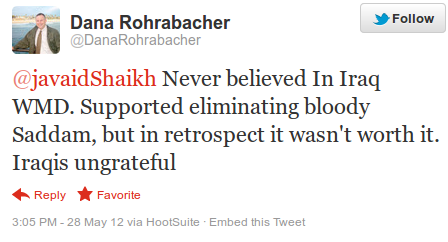 Soooo... yeah.
The "Iraqis ungrateful" part of that tweet is some of the best neo-colonial rhetoric we've heard in a while. After all we've done for them, with destroying their country, the killing of upwards of 100,000 civilians and displacing several million others... how dare they!
Never believed in Iraq WMD? Uhhhhhh, that might have been useful to know, oh I don't know, sometime fall 2002-spring 2003? People might have wanted to know that you were voting to go to war based on your desire to kill Saddam, rather than what the world was hearing as the actual justifications.
On the other hand, this is a vocal supporter of the Iraq war admitting he was wrong, even if it is for stupid, racist reasons. If it means we have to deal with more mindless neo-colonial rhetoric rather than giant wars that kill lots of people, I'll take that trade!
The "Iraqis ungrateful" part of that tweet is some of the best neo-colonial rhetoric we've heard in a while. After all we've done for them, with destroying their country, the killing of upwards of 100,000 civilians and displacing several million others... how dare they!
Never believed in Iraq WMD? Uhhhhhh, that might have been useful to know, oh I don't know, sometime fall 2002-spring 2003? People might have wanted to know that you were voting to go to war based on your desire to kill Saddam, rather than what the world was hearing as the actual justifications.
On the other hand, this is a vocal supporter of the Iraq war admitting he was wrong, even if it is for stupid, racist reasons. If it means we have to deal with more mindless neo-colonial rhetoric rather than giant wars that kill lots of people, I'll take that trade!
Thursday, March 15, 2012
"What if President Bush Did This?": Detaining Journalists Edition
With Obama's actions on Civil Liberties and the war on terror, an always interesting game is: What would be the reaction had President Bush done this?
Today's case study: "Keeping a Journalist in Prison in Yemen?"
As Glenn Greenwald pointed out in the interview I posted the other day, it's not that Obama wants to do things that are worse than what Bush did or wanted to do (He did this exact thing too! For 7 Years!), it's that when Bush did these types of things, there was usually about half the country up in arms about how bad it was. When Obama does these type of things you have a few people up in arms, mixed in with liberals at liberal institutions defending whatever the fuck Obama does because he's a Democrat, and that's OUR team dammit!
These arguments happen all the time on all kinds of issues, so I don't mean to pick on Kevin Drum, but read his defense for Obama's actions:
Do I think Obama is a nice guy? How about George W. Bush? By all personal accounts he was a really nice guy, and that clearly translated in his policy choices. Politicians, celebrities, athletes of all kinds are in the business of making themselves a brand and projecting a certain image. Since a) you don't actually know Barack Obama and b) He has a track record that you can judge him on, you should probably keep your opinions based on that. Instead you have someone who gets paid to do this shit for a living willfully ignoring real world evidence and reporting because he think's Obama is a nice guy. If our guy wasn't in the White House most people would expect better than that.
Today's case study: "Keeping a Journalist in Prison in Yemen?"
I quoted this report from FAIR because the summary was shorter, but read the incredible story by Jeremy Scahill, and the follow up from Glenn Greenwald for the full picture. It's horrifying.As Scahill reports, Shaye has "risked his life to travel to areas controlled by Al-Qaeda and to interview its leaders." He argues that this reporting has not exactly won him friends in the U.S. or Yemeni governments:His collision course with the U.S. government appears to have been set in December 2009. On December 17, the Yemeni government announced that it had conducted a series of strikes against an Al-Qaeda training camp in the village of al Majala in Yemen's southern Abyan province, killing a number of Al-Qaeda militants. As the story spread across the world, Shaye traveled to al Majala. What he discovered were the remnants of Tomahawk cruise missiles and cluster bombs, neither of which are in the Yemeni military's arsenal. He photographed the missile parts, some of them bearing the label "Made in the USA," and distributed the photos to international media outlets. He revealed that among the victims of the strike were women, children and the elderly. To be exact, 14 women and 21 children were killed.Shaye was subsequently arrested and likely tortured by Yemeni authorities, who charged and convicted him on terrorism charges. The case has drawn international attention, with media and human rights groups denouncing the trial. Pressure inside Yemen seemed to be working, and a pardon was ready for then-president Ali Abdullah Saleh to sign.Enter Barack Obama, who "expressed concern" over Shaye's release. The pardon was shelved; as Scahill reports:Yemeni journalists, human rights activists and lawyers have said he remains in jail at the request of the White House.Salon's Glenn Greenwald weighed in (3/14/12), reminding readers that the initial media accounts of the attacks in Majala were wildly misleading--the strikes were carried out by Yemen, those killed were "militants," and so on. As Greenwald puts it, the world knows the truth about this attack--which was a U.S. strike using cruise missiles and cluster bombs--because of Shaye's reporting.
As Glenn Greenwald pointed out in the interview I posted the other day, it's not that Obama wants to do things that are worse than what Bush did or wanted to do (He did this exact thing too! For 7 Years!), it's that when Bush did these types of things, there was usually about half the country up in arms about how bad it was. When Obama does these type of things you have a few people up in arms, mixed in with liberals at liberal institutions defending whatever the fuck Obama does because he's a Democrat, and that's OUR team dammit!
These arguments happen all the time on all kinds of issues, so I don't mean to pick on Kevin Drum, but read his defense for Obama's actions:
But which do I find more likely? That Shaye is indeed affiliated with al-Qaeda based on evidence that hasn't been made public? Or that Barack Obama is a sociopath who pressures foreign leaders to keep innocent journalists in prison based on the fact that they very slightly annoy him? Call me what you will, but I have to go with Door A. U.S. attacks within Yemen might be bad policy. The entire war on al-Qaeda might be bad policy. What's more, Obama — along with the entire security apparatus of the United States — might be specifically wrong about Shaye. But I don't believe that they're simply making this story up because of a basically inconsequential piece that Shaye wrote two years ago. That just doesn't add up.Why doesn't it add up? Did he find flaws in Scahill or Greenwald's reporting? Nope, he just doesn't think Obama is a bad guy, therefore mountains of evidence and reporting be damned, he's going to assume Obama is right, and the reporting is wrong. The laziness and stupidity in that response really speaks for itself.
Do I think Obama is a nice guy? How about George W. Bush? By all personal accounts he was a really nice guy, and that clearly translated in his policy choices. Politicians, celebrities, athletes of all kinds are in the business of making themselves a brand and projecting a certain image. Since a) you don't actually know Barack Obama and b) He has a track record that you can judge him on, you should probably keep your opinions based on that. Instead you have someone who gets paid to do this shit for a living willfully ignoring real world evidence and reporting because he think's Obama is a nice guy. If our guy wasn't in the White House most people would expect better than that.
Wednesday, January 11, 2012
We Are All Youssef El-Korma
Shit like this makes you proud to be a member of the human race.
Thomas Friedman visits Egypt, this happens:
Thomas Friedman visits Egypt, this happens:
"During a question-and-answer session, Friedman faced the ire of Youssef El-Korma, a member of AUC’s student leftist movement. “You can’t come here with a smile and preach to us on democracy when you’ve been demeaning Arabs and supporting war crimes in Gaza and Iraq,” said El-Korma. “We don’t welcome you here.” El-Korma’s assertions were met with applause by the audience but failed to draw a response from Friedman, who replied to another student critic earlier by saying that, "In the Middle East everybody wants to own you, and if they can't, they will try to destroy you.""
Friday, December 16, 2011
War, What is It Good For?
Juan Cole, listing the cost of the Iraq war:
Moreover, the American public still for the most part has no idea what the United States did to that country, and until we Americans take responsibility for the harm we do others with our perpetual wars, we can never recover from our war sickness, which drives us to resort to violence in international affairs in a way no other democracy routinely does.No words.
Population of Iraq: 30 million.
Number of Iraqis killed in attacks in November 2011: 187
Average monthly civilian deaths in Afghanistan War, first half of 2011: 243
Percentage of Iraqis who lived in slum conditions in 2000: 17
Percentage of Iraqis who live in slum conditions in 2011: 50
Number of the 30 million Iraqis living below the poverty line: 7 million.
Number of Iraqis who died of violence 2003-2011: 150,000 to 400,000.
Orphans in Iraq: 4.5 million.
Orphans living in the streets: 600,000.
Number of women, mainly widows, who are primary breadwinners in family: 2 million.
Iraqi refugees displaced by the American war to Syria: 1 million
Internally displaced [pdf] persons in Iraq: 1.3 million
Proportion of displaced persons who have returned home since 2008: 1/8
Rank of Iraq on Corruption Index among 182 countries: 175
Friday, November 25, 2011
At Least Paul Wolfowitz Had A Terrible Thanksgiving
Also, Jeremy Scahill is an American hero. From his twitter feed:
Just randomly ran into Paul Wolfowitz. Told him what I think of him. The words "war" & "criminal" were involved.
Wolfowitz tried to keep walking. A family member of his started screaming at me & cursing, called me a "coward."
I told Wolfowitz he belongs in prison, not asking questions at GOP debates.
It's true, he should be in prison, not asking questions at GOP debates. I had similar thoughts during the debate!
Wednesday, September 14, 2011
The Patriot Act At Work
A really amazing graph showing the number of "sneak and peak" raids from 2006-2009, and their purpose:

Friday, August 26, 2011
Fuck Dick Cheney
Dick Cheney should be in prison.
Instead, he released a memoir bragging about the acts that should have put him in jail.
Chris Hayes and Glenn Greenwald addressed it brilliantly last night:
Instead, he released a memoir bragging about the acts that should have put him in jail.
Chris Hayes and Glenn Greenwald addressed it brilliantly last night:
Thursday, June 16, 2011
Just How Fucked Up Was The Bush Administration?
As someone who is a regular reader of Juan Cole's blog Informed Comment (and was during the Iraq war), this definitely caught my attention:
Glenn L. Carle, a former Central Intelligence Agency officer who was a top counterterrorism official during the administration of President George W. Bush, said the White House at least twice asked intelligence officials to gather sensitive information on Juan Cole, a University of Michigan professor who writes an influential blog that criticized the war.Juan's take:
In an interview, Mr. Carle said his supervisor at the National Intelligence Council told him in 2005 that White House officials wanted “to get” Professor Cole, and made clear that he wanted Mr. Carle to collect information about him, an effort Mr. Carle rebuffed. Months later, Mr. Carle said, he confronted a C.I.A. official after learning of another attempt to collect information about Professor Cole. Mr. Carle said he contended at the time that such actions would have been unlawful.
It is not clear whether the White House received any damaging material about Professor Cole or whether the C.I.A. or other intelligence agencies ever provided any information or spied on him. Mr. Carle said that a memorandum written by his supervisor included derogatory details about Professor Cole, but that it may have been deleted before reaching the White House. Mr. Carle also said he did not know the origins of that information or who at the White House had requested it.
Carle’s revelations come as a visceral shock. You had thought that with all the shennanigans of the CIA against anti-Vietnam war protesters and then Nixon’s use of the agency against critics like Daniel Ellsberg, that the Company and successive White Houses would have learned that the agency had no business spying on American citizens.Pretty unbelievable stuff.
I believe Carle’s insider account and discount the glib denials of people like Low. Carle is taking a substantial risk in making all this public. I hope that the Senate and House Intelligence Committees will immediately launch an investigation of this clear violation of the law by the Bush White House and by the CIA officials concerned. Like Mr. Carle, I am dismayed at how easy it seems to have been for corrupt WH officials to suborn CIA personnel into activities that had nothing to do with national security abroad and everything to do with silencing domestic critics. This effort was yet another attempt to gut the Fourth Amendment of the US Constitution, in this case as part of an effort to gut the First Amendment of the US Constitution.
I should point out that my blog was begun in 2002 with an eye toward analyzing open source information on the struggle against al-Qaeda. In 2003 I also began reporting on the unfolding Iraq War. My goal was to help inform the public and to present sources and analysis on the basis of my expertise as a Middle East and South Asia expert. In 2003-2005 and after I on a few occasions was asked to speak to military and intelligence professionals, most often as part of an inter-agency audience, and I presented to them in person distillations of my research. I never had a direct contract with the CIA, but some of the think tanks that every once in a while asked me to speak were clearly letting analysts and field officers know about the presentations (which were most often academic panels of a sort that would be mounted at any academic conference), and they attended. I should underline that these presentations involved small travel expenses and a small honorarium, and that I wasn’t a high-paid consultant but clearly was expected to speak my views and share my conclusions frankly. It was not a regular gig. Apparently one of the purposes of spying on me to discredit me, from the point of view of the Bush White House, was ironically to discourage Washington think tanks from inviting me to speak to the analysts, not only of the CIA but also the State Department Intelligence and Research and other officials concerned with counter-terrorism and with Iraq.
It seemed likely to some colleagues, according to what they told me, that the Bush administration had in fact succeeded in having me blackballed, since the invitations rather dropped off, and panels of a sort I had earlier participated in were being held without my presence. I do not know if smear tactics were used to produce this result, behind the scenes and within the government. It was all the same to me– I continued to provide what I believe was an important service to the Republic at my blog and I know for a fact that not only intelligence analysts but members of the Bush team continued to read some of what I wrote.
What alarms me most of all in the nakedly illegal deployment of the CIA against an academic for the explicit purpose of destroying his reputation for political purposes is that I know I am a relatively small fish and it seems to me rather likely that I was not the only target of the baleful team at the White House. After the Valerie Plame affair, it seemed clear that there was nothing those people wouldn’t stoop to. You wonder how many critics were effectively “destroyed.” It is sad that a politics of personal destruction was the response by the Bush White House to an attempt of a citizen to reason in public about a matter of great public interest. They have brought great shame upon the traditions of the White House, which go back to George Washington, Thomas Jefferson, and James Madison, who had hoped that checks and balances would forestall such abuses of power.
Wednesday, May 11, 2011
People Should Be In Jail
I came across this interview from 2009 doing research for work, and was reminded how good it was.
William Black should be nominated for something important, preferably 5 years ago.
William Black should be nominated for something important, preferably 5 years ago.
Tuesday, May 3, 2011
The Right Wing Torture Fantasies Won't Quit
After Bin Laden was killed under the Kenyan usurper reign, I'd been wondering what fantasy the right would create to make this somehow their success. We have a winner!
Like so many memes that persist in politics, this one started on the Internet. The morning after President Obama announced that Osama bin Laden had been killed in Pakistan, conservatives started crowing that credit should be given to President George W. Bush -- specifically, for having the foresight and courage to torture the people who provided the initial scraps of intel that ultimately led the CIA to a giant compound just north of Islamabad.
The most prominent of these conservatives was Rep. Steve King (R-IA), who took to Twitter to ask sardonically, "Wonder what President Obama thinks of water boarding now?
About two hours later, the Associated Press published a brief story claiming that the CIA obtained the initial intelligence it needed to find bin Laden from Khalid Sheikh Mohammed -- the so-called mastermind of 9/11 -- and his successor, Abu Faraj al-Libi at CIA black sites in Poland and Romania.
Those secret prisons, which the Obama administration contends to have abandoned, were the facilities where Mohammed and al-Libi were waterboarded. There, the detainees supposedly identified by nom de guerre a courier who would years later be located by American intelligence officials, and lead them to bin Laden's compound.
"The news is sure to reignite debate over whether the now-closed interrogation and detention program was successful," the AP wrote. "Former president George W. Bush authorized the CIA to use the harshest interrogation tactics in U.S. history. President Barack Obama closed the prison system."
There's just one problem. The key bit of intel wasn't acquired via torture, according to a more fleshed out version of the same report.
Subscribe to:
Posts (Atom)