
Next Wednesday is March 10th, which is a very significant date in Tibetan history- the anniversary of the 1959 Tibetan Uprising, which had been set in motion years earlier by guerrilla resistance in the eastern region of Kham and finally erupted in Lhasa on March 10th. Obviously the uprising failed to expel the Chinese occupiers, and days later the Dalai Lama escaped to India. Next week I’ll have more about how that started and exactly what happened.
For now, the timely connection is that Beijing has launched yet another “Strike Hard” campaign in anticipation of the anniversary. For those not familiar with the term, “Strike Hard” campaigns are periods where officials and enforcement bodies are specifically encouraged to disregard the usual limits of the law and go wild. Any offense, regardless of how slight, can be used as an excuse for beatings, torture, lengthy imprisonments, or even executions. They’ve become an annual fixture around March 10th, because Beijing hopes to intimidate Tibetans who would recognize the anniversary.
For the time being, then, anything can serve as an excuse to punish Tibetans. Listening to a pop song which obliquely references the Dalai Lama within earshot of a policeman, failing to be appropriately reverent of the Chinese flag, looking at a Communist Party member less than lovingly- anything will do. Even by the usual standards, the next few weeks will be dangerous ones for Tibetans inside Tibet.
Next, the Chinese People’s Political Consultative Conference has announced their list of new members for the year. This body has little power of its own, but a seat on the CPPCC is viewed as a cushy reward for retiring government figures, or for rich businessmen. The list of new appointments surprised observers with its inclusion of Gyaincain Norbu, the fake Panchen Lama.
The real Panchen Lama, the one chosen by the Dalai Lama and a number of prominent Tibetan Buddhists, still hasn’t been heard from since 1995, when he was abducted by the Chinese government at the age of 6. The reason behind the abduction was obvious- the replacement offered by Beijing is the son of two Communist Party members, and has been used as a transparent ploy to subvert Tibetan religion to aid the occupation. The attempt has failed, though: Tibetans refer to Gyaincain Norbu as the “Panchen Zuma,” or fake Panchen. The name has stuck, and today if you type “Panchen Zuma” into Wikipedia it will automatically redirect you to the Chinese-picked candidate.
His appointment to the CPPCC is an attempt by Beijing to up the ante. Instead of reconsidering their plan, they’ve doubled down and given him a prominent political position. Their attempted smearing of the Dalai Lama as a politician in monk’s robes is even more ironic now, with their creation of a supposed high lama who is openly just a pro-Beijing politician. He was ignored by the other delegates at the 2006 World Buddhist Forum, but damned if he won’t do a great job of talking about how great China has been for Tibet!
That wasn’t the only reason Beijing abducted the real Panchen Lama, though. Traditionally the Panchen Lamas have been tasked with identifying the next Dalai Lama. The end goal of the Chinese plan is to use the fake Panchen to lend legitimacy to their choice of a fake Dalai after the current Dalai Lama passes away. More on what that will mean and what the exiled Tibetan community is doing to prepare for it some other time.
Thursday, March 4, 2010

Real Financial Reform In Serious Danger
Following the model set by the Health Care negotiations, the most important part of the financial reform bill could be gutted in the Senate:
Consumer advocates are reacting harshly to a compromise Consumer Financial Protection Agency being proposed by Banking Committee Chairman Chris Dodd (D-Conn.).It's good to know that Senator Dodd's love of the banking industry is so deep that he'll continue to be in their pocket even when he doesn't have to worry about reelection. Elizabeth Warren has it right about idea about how to deal with Dodd and the rest of the Senate:
HuffPost and other media outlets have obtained a copy of a memo outlining the proposal that Dodd sent to committee members this weekend. Read the memo here.
Under Dodd's plan, "[t]he agency proposal would be dropped." Consumer groups and labor unions had been pushing for independence as key to the agency's success. Bank regulators, they argued, should not have authority to veto consumer protection rules, because they have the interests of the banking sector as their central priority, rather than concern for abusive practices.
Consumer groups also wanted a presidentially-appointed head of the agency and an independent funding stream. Dodd's proposal includes both of those. But without independence, the agency loses its ability to write or enforce strong rules.
"My first choice is a strong consumer agency," the Harvard Law professor and federal bailout watchdog said in an interview with the Huffington Post. "My second choice is no agency at all and plenty of blood and teeth left on the floor."Without an independent consumer agency, it isn't real financial reform, and this is a fight we need to pick. From the early signs of it, the White House might be getting the message:
WASHINGTON (AP) -- The Obama administration waded into negotiations over Wall Street regulations Wednesday, calling for limits on the size of financial institutions and insisting that consumer protections remain a central objective of legislative attempts to rein in the industry.This is a massive departure from the previous actions the Administration has taken on Banking policy, which is great news. The other encouraging news is people such as Paul Krugman have already begun saying that no bill is better than Dodd's gutted bill. If those threats start to be taken seriously, then it could get the momentum for a bill going back in the right direction.
The plan reiterated a proposal that the administration staked out in January. The measure is known as the Volcker Rule, after former Federal Reserve Chairman Paul Volcker, a vigorous proponent of limiting proprietary trading by commercial banks. Volcker has been advising the Obama administration.
Wednesday, March 3, 2010
SCOTUS Docket Watch – McDonald v. City of Chicago : Part I
This week’s look at the Supreme Court takes us to the current case of McDonald v. City of Chicago to decide whether the 2nd Amendment is applicable to the States.
This case follows the previous DC v. Heller (2008) decision which declared the District’s ban on handguns and its requirement to keep all legal firearms unloaded/trigger locked unconstitutional. The Court reasoned that the 2nd Amendment protects an “individual’s right to possess a firearm, unconnected with service in a militia…”, which includes use for lawful purposes and home self-defense. This decision extended the 2nd Amendment to private use in federal enclaves (including the District of Columbia), but the Court refused to decide on the issue of whether or not the same principle would apply to States.
The 2nd Amendment promises that “A well regulated Militia being necessary to Security of a Free State, the right of the people to keep and bear Arms, shall not be infringed.” As part of the Bill of Rights, this amendment historically has not been applied directly to the states.
Scholars have and will likely continue to debate whether the framers intended the Bill of Rights to apply solely to the federal government, or also to the States. In 1833, the Court ruled in Barron v. Baltimore that the Fifth Amendment takings clause guarantee (federal government must provide just compensation if they seize private property for public use) only applied to restrict federal government. For the most part, the underlying rationale limiting the amendment’s application to the state’s has been upheld.
After Reconstruction, the Court’s philosophy changed, and they began recognizing that most of the Bill of Rights Amendments did apply to the states, through the 14th Amendment’s Due Process Clause, which states that “No state shall make or enforce any law … nor shall any state deprive any person of life, liberty, or property, without due process of law…” In this case, respondent's argue that the 2nd Amendment’s right to bear arms is fundamental to liberty, and the protection should extend to the States.
In this case, the petitioners seek to overturn gun registration restrictions for shotguns, rifles, ect. and a handgun ban in Chicago for being unconstitutional. The trial court ruled for the City of Chicago, saying that the City’s gun ban and restrictions were constitutional. This decision was upheld on appeal, and the Supreme Court granted certiorari to hear the case in September. Interestingly, the Supreme Court is allowing the NRA to argue separately for the Plaintiff’s position; so both the NRA and McDonald will have to split their oral argument time before the Court.
Tune in next time, when we have the chance to listen to oral arguments before the Court and for a recap on the main arguments.
Obama Endorses RI's "Fire All Teachers" Plan
I'm sure that having no teachers will turn around those dipping test scores:
Well, the good news is that the Bush Era is over, and organized labor worked so hard to elect someone who would speak out against this kind of nonsense:
As Michael Whitney points out, it's also good to line this up with how Obama has treated the fuck ups in the financial sector:
School is under preforming?
Obama: Firing all the teachers is an appropriate solution.
Recklessness on Wall Street that tanks the entire US Economy?
Obama: Everyone keeps their jobs, works hard behind the scenes to protect their bonuses.
This is truly shameful, and fairly shocking that he would go out of his way to applaud it. If I wanted a union buster in the White House, I would have voted for Hillary Clinton.
Again, regardless of how you feel about different approaches to education reform, I'm still not sure at what point firing all the teachers starts to look like a sensible idea. I'm sure all the replacement teachers with no experience that fill EVERY POSITION IN THE SCHOOL will have no problems learning how to be a full time teacher while improving the declining test scores that the superintendent was so upset about.In the middle of the worst jobs crisis since the Great Depression, more than 90 dedicated professional educators find themselves put out into the street. On Feb. 23, the Central Falls, R.I., school trustees fired the entire teaching staff of Central Falls High School, supposedly because of declining test scores at the school, which is located in Rhode Island’s smallest and poorest city.
In all, 93 persons were put in the street—74 classroom teachers, plus reading specialists, guidance counselors, physical education teachers, the school psychologist, the principal and three assistant principals. Negotiations over ways to improve the school between teachers and the school superintendent broke down when school officials insisted that teachers add new duties, some without any extra pay at all.
In a rally before the trustees meeting, some 500 union members and community supporters called on the board to reconsider its decision. Rhode Island AFL-CIO President George Nee told the crowd:
This is immoral, illegal, unjust, irresponsible, disgraceful and disrespectful. What is happening here tonight is the wrong thing and we’re not going to put up with it.
Busloads of teachers from across the state came to show solidarity with the Central Falls teachers. Julie Boyle, an English teacher at another high school, told the Providence Journal:
I think the real goal is to bust the unions. Sometimes a teacher is the only touchstone in a student’s life. I’m sad for the students who will lose their touchstones.
Well, the good news is that the Bush Era is over, and organized labor worked so hard to elect someone who would speak out against this kind of nonsense:
President Obama voiced support Monday for the mass firings of educators at a failing Rhode Island school, drawing an immediate rebuke from teachers union officials whose members have chafed at some of his education policies.Obama has yet to see any significant push back from labor on almost anything, but this has to cross some sort of line. This isn't indifference, this is lending backing to a worldview that doesn't believe organized labor has a right to exist.
Speaking at an event intended to highlight his strategy for turning around struggling schools by offering an increase in federal funding for local districts that shake up their lowest-achieving campuses, Obama called the controversial firings justified.. . .Meanwhile, state and local education officials received some high-powered support of their own, when U.S. Education Secretary Arne Duncan weighed in, saying he “applauded” them for “showing courage and doing the right thing for kids.” [...]
“This is hard work and these are tough decisions, but students only have one chance for an education,” Education Secretary Duncan said, “and when schools continue to struggle we have a collective obligation to take action.”
As Michael Whitney points out, it's also good to line this up with how Obama has treated the fuck ups in the financial sector:
School is under preforming?
Obama: Firing all the teachers is an appropriate solution.
Recklessness on Wall Street that tanks the entire US Economy?
Obama: Everyone keeps their jobs, works hard behind the scenes to protect their bonuses.
This is truly shameful, and fairly shocking that he would go out of his way to applaud it. If I wanted a union buster in the White House, I would have voted for Hillary Clinton.
Tuesday, March 2, 2010
The Awesomeness of Repeated Failures
You have been warned. The first three paragraphs of this Washington Post article (dictated, not typed by Rahm Emanuel) are filled with so much bullshit it will make your head spin:
It's actually just as hard to think of a time when he didn't go for a watered down Republican idea at expense something that might actually work.
There's a reason Rahm is ghostwriting all these articles and trying to save his legacy. The Obama administration was has been run exactly how Rahm wanted it done. He knows those failures are on him, and none are bigger than Health Care, which was run like his own personal Blueprint on how to pass a bill.
I understand why he's trying to rehabilitate his legacy. Why the Washington Post feels the need to transcribe his alternate reality in their news section is beyond me.
Rahm Emanuel is officially a Washington caricature. He's the town's resident leviathan, a bullying, bruising White House chief of staff who is a prime target for the failings of the Obama administration.Why is Rahm a caricature? I'm sure the dozens of fawning tributes that the post has run over the past year have nothing to do with this at all. He may be a prime target for some, but you sure wouldn't notice that if you read the post.
But a contrarian narrative is emerging: Emanuel is a force of political reason within the White House and could have helped the administration avoid its current bind if the president had heeded his advice on some of the most sensitive subjects of the year: health-care reform, jobs and trying alleged terrorists in civilian courts.A contrarian narrative where the president's chief of staff was mysteriously not involved with any of the Administration's failures?
It is a view propounded by lawmakers and early supporters of President Obama who are frustrated because they think the administration has gone for the perfect at the expense of the plausible. They believe Emanuel, the town's leading purveyor of four-letter words, a former Israeli army volunteer and a product of a famously argumentative family, was not aggressive enough in trying to persuade a singularly self-assured president and a coterie of true-believer advisers that "change you can believe in" is best pursued through accomplishments you can pass.I want you to re-read that first sentence, just to make sure you understand that this was printed without comment in a publication that once broke the watergate scandal:
It is a view propounded by lawmakers and early supporters of President Obama who are frustrated because they think the administration has gone for the perfect at the expense of the plausible.Can you name something, no matter how small, in Obama's first year where you can claim he went for the perfect at the expense of the plausible?
It's actually just as hard to think of a time when he didn't go for a watered down Republican idea at expense something that might actually work.
There's a reason Rahm is ghostwriting all these articles and trying to save his legacy. The Obama administration was has been run exactly how Rahm wanted it done. He knows those failures are on him, and none are bigger than Health Care, which was run like his own personal Blueprint on how to pass a bill.
I understand why he's trying to rehabilitate his legacy. Why the Washington Post feels the need to transcribe his alternate reality in their news section is beyond me.
Monday, March 1, 2010
The Beginning of the End for Blanche Lincoln
A great, great day for the future of the Democratic Party:
Much more on this race later, but enjoy the the very real possibility that one of the Senate's worst members will be losing their jobs.
Conservative Democrat Blanche Lincoln (D-Ark.), whose obstinacy during the health care reform process was so frustrating to the progressive community, is officially getting a primary challenge.Blanche Lincoln is one of the worst (if not the worst) member of the Democratic Caucus. She was going to lose reelection anyway, so Bill Halter gives us the chance to both upgrade the quality of Senator and a real shot at keeping the seat.
On Monday morning, Arkansas lieutenant governor, Bill Halter, announced that he would launch a campaign to dislodge Lincoln from her Senate seat. He cited a need to focus on middle class issues, take on Wall Street, and fight back against special interests.
Much more on this race later, but enjoy the the very real possibility that one of the Senate's worst members will be losing their jobs.
On the Eve of Obama's Nuclear Posture Review & Fifty Six Years After Castle Bravo: Ruminations on the History and Future of Nuclear Weapons
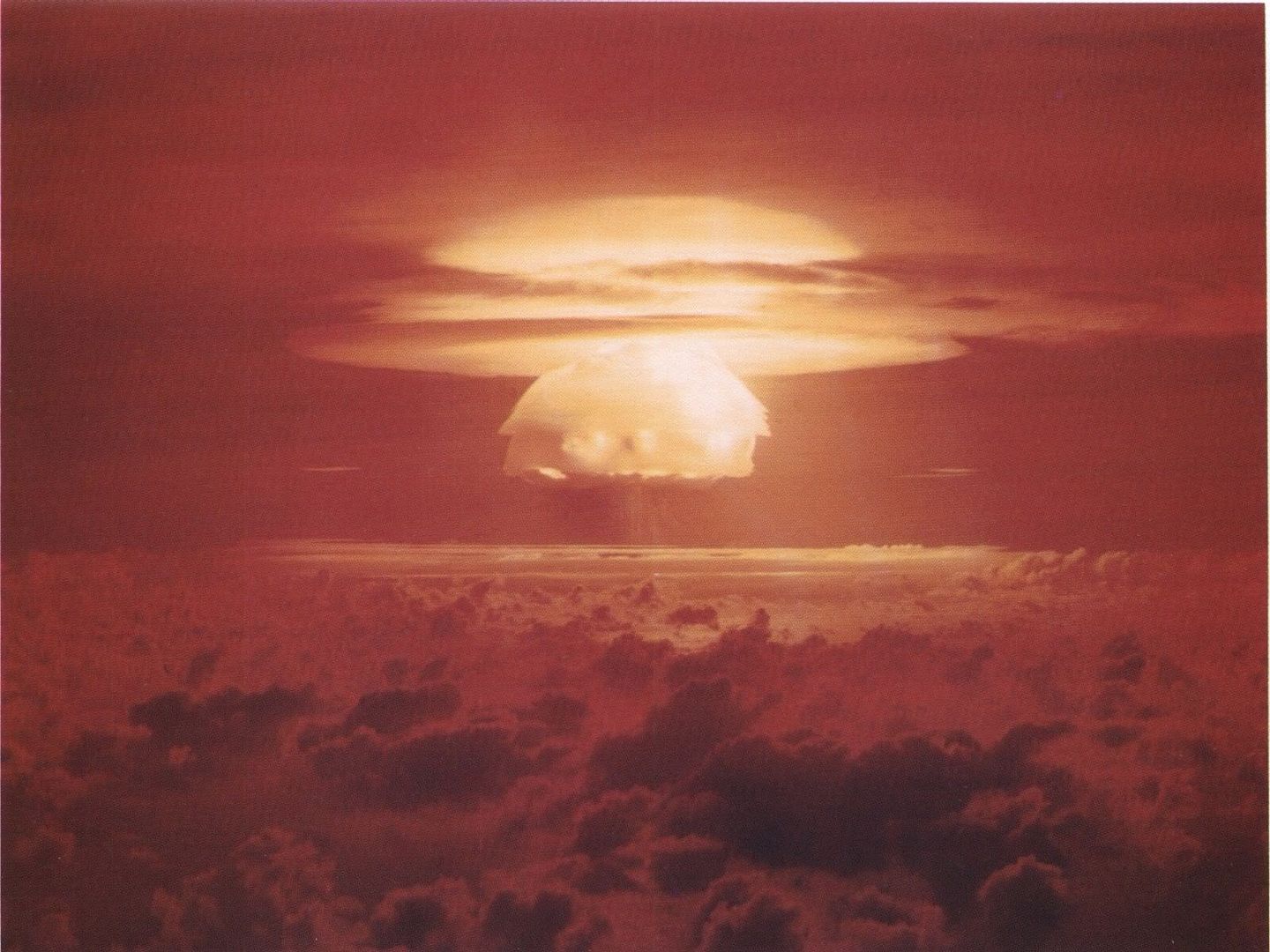
Today marks the 56th anniversary of the Castle Bravo nuclear test. As the largest-ever weapons test conducted by the United States, and the first test of a deliverable hydrogen bomb on the planet, there's a sense in which today is a more real anniversary of the nuclear age than Trinity (the first nuclear test), or even Hiroshima (the first wartime nuclear deployment). The blast, equivalent to 15,000,000 tons (15 megatons) of TNT, was conservatively 750 times more powerful than these earlier bombs, and three times as potent as the scientists conducting the test predicted. It spread so much harmful radiation over such a large swath of the south pacific that belatedly-evacuated islanders suffered illness and birth defects while a Japanese fisherman was killed outright and massive contaminated fish harvests had to be scrapped. Reaction to the uncontrolled test is a textbook case of how nuclear reforms come about: just as we discover greater nuclear power, its consequences immediately inspire the desire to control or even undo the advance. In this case, the damages caused by the loose radiation led directly to the limitation of above-ground testing and slowed the pursuit of higher weapon yield.
As critical as I can be of the current administration, there's one issue where Obama – so far – deserves all of the credit we can give him. By pledging to rid the world of nuclear weapons, he has not only repudiated an orthodoxy that has held sway in the upper echelons of the United States government since Harry Truman, but pushed the world towards a security it hasn't had in sixty years.
Though the threat of global nuclear war has faded since the collapse of the Soviet Union, the likelihood of nuclear terrorism is as high as ever. It remains unclear whether and how many "suitcase" bombs were lost during Russia's reorganization in the 1990s, and there is no way to account for every piece of nuclear material from the hundreds of refinement and storage sites throughout the former Soviet Union. And as unstable dictatorships like North Korea and Libya make bids for membership in the nuclear club (successful or not), Iran's increasing nuclear ambitions look downright sensible.
More alarmingly, even an engagement between "minor" nuclear powers like India and Pakistan would likely have apocalyptic effects. Scientists Micahel Mills and Owen Brian Toon recently re-ran the old nuclear winter experiments with the faster computers and more advanced climate models that we have today, on the assumption of a 100 sub-megaton bomb exchange (in keeping with Indian and Pakistani capabilities). Their conclusions? In addition to causing ten times more damage to the ozone layer than all the CFCs ever released, the firestorms caused by the explosions would put such a massive amount of smoke into the upper atmosphere that agriculture would be rendered untenable, worldwide, for as long as ten years.
To put this in perspective, the Federation of American Scientists estimates that there are approximately 23,000 nuclear weapons in the world, many of which are decidedly not in the sub-megaton range. The majority (21,400) are held by the United States and Russia, with the remainder spread (in decreasing numerical order) between France, China, the United Kingdom, Israel, Pakistan, India and North Korea.
Thus, the genius of Stanley Kubrick's Dr. Strangelove: Or, How I Learned to Stop Worrying and Love the Bomb is not just its damned accurate portrayal of the paranoiac cold war strategic mentality. It's that the doomsday device developed by the Russians as a deterrent precisely describes the world in which we've been living since the 1950s.
_______________
So when I saw Ross Douhat's New York Times op-ed a few weeks ago about Obama's arms control plans – published perhaps a month before Obama's Nuclear Posture Review is due – I had a moment of hope: maybe the disarmament of our biggest international death trap is something we can finally agree upon, politically.
Nope. Of course not. Eliminating the largest threat humanity has ever faced wouldn't be in keeping with a "conservative" viewpoint at all, would it?
In fairness, Douhat, like most post-Carter presidents, is in favor of stockpile reduction. Even he recognizes that there literally is no contingency in which the United States would need all of its 9,400 nukes (2,700 of which are actively deployed at this very moment). But there the sanity ends.
Like so many cold war game theorists, Douhat clings to the illusion that the bomb is a deterrent that keeps America and its allies safe, rather seeing it for what it is: a gun that, when fired, will explode and kill everyone in the room. It’s not even that he’s wrong about the points he makes. It may very well be that countries like Turkey only refrain from pursuing nukes because they fall under NATO’s nuclear protection; it may well be that Iraq’s nuclear aspirations had everything to do with counterbalancing America’s advantages in conventional arms, rather than matching its nuclear capabilities; it may even be the case that America’s bombs are an essential part of the deterrent, or will become an essential part of the deterrent, to radical, nuclear-armed countries like Iran and North Korea.
But to focus on particulars like these as an argument against the eventual, total elimination of nuclear weapons is to utterly and dangerously fail to understand what they are. The more we learn about what these bombs do, the clearer it becomes that we can never, ever use them. It doesn't matter who has more, or whether one side can more thoroughly destroy another first. It does not even matter what country has them in a more than incidental sense. The destructive power of nuclear weapons is simply so great that their existence in these numbers is a direct threat to all higher life on the planet.
Let us take a step back from North Korea and Iran, and even from the Soviet Union: is there cause to trust the United States government with so great a power? Can you name an individual, group or an agency in whom you would entrust the ability to end all human life? Because this is not a hypothetical question. We have chosen twelve individuals thus far, and choose again every four years. And while we may give them credit for the fact that we’re still here, a closer look at the history of near-confrontations reveals a far scarier picture.
If you haven’t already seen it, then watch the first twenty minutes or so of Errol Morris's Fog of War and listen to Robert McNamara, secretary of defense during the Cuban missile crisis, describe just how close our country’s highest standard of "rational individuals" (McNamara's words) came to obliterating the planet during those two weeks in 1962. Even with all the benefits of time to sleep on a decision and speak with the adversary, we came “within a hair’s breadth” of nuclear war.
Today, we no longer have the luxury of weeks or days. Since the development of ICBMs (Intercontinental Ballistic Missiles), SLBMs (Submarine-launched Ballistic Missiles) and forward-deployed MRBMs (Medium Range Ballistic Missiles), most of which contain multiple independently targetable warheads used to completely blanket a target area, the time for thought has shrunk to mere minutes.
Perhaps the second greatest close call occurred during the Able Archer 83 NATO exercise in 1983, when deployment of Pershing II missiles to West Germany (capable of reaching their targets in Russia within four to six minutes of launch) coincided with a NATO simulation of an escalating nuclear conflict about which NATO utterly failed to notify the Soviet Union. Unbeknownst to the west, Russian panic and preparation for massive nuclear retaliation escalated until NATO simulation reached DEFCON 1 with no subsequent launch of thousands of missiles. Had the false radar blips experienced by the Russian watch system days before Able Archer occurred as the exercise reached its hot point; had Russia decided that its intelligence pointed irrefutably to a NATO first strike attempt; and perhaps even more plausibly, had the tensions felt by the lower echelons of the Soviet army manifested themselves in smaller conventional engagements with NATO forces; we would very likely not be here today.
So you can see, then, how Dr. Strangelove’s most genius, scariest moment, is its end. Suspicious of the Americans and enticed by the prospect of life in a mineshaft with dozens of attractive women for breeding, the Russian ambassador actively chooses to set off the doomsday device, ending in an instant humanity's prospects for the next century of above-ground life.
It is all too human to think that we are worthy of such a charge. But to be painfully honest: we are not worthy. We need to do everything in our power to destroy those weapons that already exist and make it as difficult as possible to make more. In the short term, tactically, people like Douhat may be right that the United States's stockpile is a tool for achieving this end. But even if there were not real reasons to doubt this argument on its face, citizens of this country need to take a realistic appraisal of our own responsibility in maintaining and proliferating the nuclear mindset.

As critical as I can be of the current administration, there's one issue where Obama – so far – deserves all of the credit we can give him. By pledging to rid the world of nuclear weapons, he has not only repudiated an orthodoxy that has held sway in the upper echelons of the United States government since Harry Truman, but pushed the world towards a security it hasn't had in sixty years.
Though the threat of global nuclear war has faded since the collapse of the Soviet Union, the likelihood of nuclear terrorism is as high as ever. It remains unclear whether and how many "suitcase" bombs were lost during Russia's reorganization in the 1990s, and there is no way to account for every piece of nuclear material from the hundreds of refinement and storage sites throughout the former Soviet Union. And as unstable dictatorships like North Korea and Libya make bids for membership in the nuclear club (successful or not), Iran's increasing nuclear ambitions look downright sensible.
More alarmingly, even an engagement between "minor" nuclear powers like India and Pakistan would likely have apocalyptic effects. Scientists Micahel Mills and Owen Brian Toon recently re-ran the old nuclear winter experiments with the faster computers and more advanced climate models that we have today, on the assumption of a 100 sub-megaton bomb exchange (in keeping with Indian and Pakistani capabilities). Their conclusions? In addition to causing ten times more damage to the ozone layer than all the CFCs ever released, the firestorms caused by the explosions would put such a massive amount of smoke into the upper atmosphere that agriculture would be rendered untenable, worldwide, for as long as ten years.
To put this in perspective, the Federation of American Scientists estimates that there are approximately 23,000 nuclear weapons in the world, many of which are decidedly not in the sub-megaton range. The majority (21,400) are held by the United States and Russia, with the remainder spread (in decreasing numerical order) between France, China, the United Kingdom, Israel, Pakistan, India and North Korea.
Thus, the genius of Stanley Kubrick's Dr. Strangelove: Or, How I Learned to Stop Worrying and Love the Bomb is not just its damned accurate portrayal of the paranoiac cold war strategic mentality. It's that the doomsday device developed by the Russians as a deterrent precisely describes the world in which we've been living since the 1950s.
So when I saw Ross Douhat's New York Times op-ed a few weeks ago about Obama's arms control plans – published perhaps a month before Obama's Nuclear Posture Review is due – I had a moment of hope: maybe the disarmament of our biggest international death trap is something we can finally agree upon, politically.
Nope. Of course not. Eliminating the largest threat humanity has ever faced wouldn't be in keeping with a "conservative" viewpoint at all, would it?
In fairness, Douhat, like most post-Carter presidents, is in favor of stockpile reduction. Even he recognizes that there literally is no contingency in which the United States would need all of its 9,400 nukes (2,700 of which are actively deployed at this very moment). But there the sanity ends.
Like so many cold war game theorists, Douhat clings to the illusion that the bomb is a deterrent that keeps America and its allies safe, rather seeing it for what it is: a gun that, when fired, will explode and kill everyone in the room. It’s not even that he’s wrong about the points he makes. It may very well be that countries like Turkey only refrain from pursuing nukes because they fall under NATO’s nuclear protection; it may well be that Iraq’s nuclear aspirations had everything to do with counterbalancing America’s advantages in conventional arms, rather than matching its nuclear capabilities; it may even be the case that America’s bombs are an essential part of the deterrent, or will become an essential part of the deterrent, to radical, nuclear-armed countries like Iran and North Korea.
But to focus on particulars like these as an argument against the eventual, total elimination of nuclear weapons is to utterly and dangerously fail to understand what they are. The more we learn about what these bombs do, the clearer it becomes that we can never, ever use them. It doesn't matter who has more, or whether one side can more thoroughly destroy another first. It does not even matter what country has them in a more than incidental sense. The destructive power of nuclear weapons is simply so great that their existence in these numbers is a direct threat to all higher life on the planet.
Let us take a step back from North Korea and Iran, and even from the Soviet Union: is there cause to trust the United States government with so great a power? Can you name an individual, group or an agency in whom you would entrust the ability to end all human life? Because this is not a hypothetical question. We have chosen twelve individuals thus far, and choose again every four years. And while we may give them credit for the fact that we’re still here, a closer look at the history of near-confrontations reveals a far scarier picture.
If you haven’t already seen it, then watch the first twenty minutes or so of Errol Morris's Fog of War and listen to Robert McNamara, secretary of defense during the Cuban missile crisis, describe just how close our country’s highest standard of "rational individuals" (McNamara's words) came to obliterating the planet during those two weeks in 1962. Even with all the benefits of time to sleep on a decision and speak with the adversary, we came “within a hair’s breadth” of nuclear war.
Today, we no longer have the luxury of weeks or days. Since the development of ICBMs (Intercontinental Ballistic Missiles), SLBMs (Submarine-launched Ballistic Missiles) and forward-deployed MRBMs (Medium Range Ballistic Missiles), most of which contain multiple independently targetable warheads used to completely blanket a target area, the time for thought has shrunk to mere minutes.
Perhaps the second greatest close call occurred during the Able Archer 83 NATO exercise in 1983, when deployment of Pershing II missiles to West Germany (capable of reaching their targets in Russia within four to six minutes of launch) coincided with a NATO simulation of an escalating nuclear conflict about which NATO utterly failed to notify the Soviet Union. Unbeknownst to the west, Russian panic and preparation for massive nuclear retaliation escalated until NATO simulation reached DEFCON 1 with no subsequent launch of thousands of missiles. Had the false radar blips experienced by the Russian watch system days before Able Archer occurred as the exercise reached its hot point; had Russia decided that its intelligence pointed irrefutably to a NATO first strike attempt; and perhaps even more plausibly, had the tensions felt by the lower echelons of the Soviet army manifested themselves in smaller conventional engagements with NATO forces; we would very likely not be here today.
So you can see, then, how Dr. Strangelove’s most genius, scariest moment, is its end. Suspicious of the Americans and enticed by the prospect of life in a mineshaft with dozens of attractive women for breeding, the Russian ambassador actively chooses to set off the doomsday device, ending in an instant humanity's prospects for the next century of above-ground life.
It is all too human to think that we are worthy of such a charge. But to be painfully honest: we are not worthy. We need to do everything in our power to destroy those weapons that already exist and make it as difficult as possible to make more. In the short term, tactically, people like Douhat may be right that the United States's stockpile is a tool for achieving this end. But even if there were not real reasons to doubt this argument on its face, citizens of this country need to take a realistic appraisal of our own responsibility in maintaining and proliferating the nuclear mindset.
Subscribe to:
Posts (Atom)