
The news never stops, does it?
Thursday, November 7, 2019

Monday, November 7, 2016
Back on the Tracks - an Election 2016 First/last Look
Greetings Friends, it has been a long time since we last talked.
There is not too much left to say, this election season we laughed, we cried, we drank, we passed out in shock at what was going on all around us.
Please enjoy this little number as our thanks for sticking with U-S.
There is not too much left to say, this election season we laughed, we cried, we drank, we passed out in shock at what was going on all around us.
Please enjoy this little number as our thanks for sticking with U-S.
Thursday, April 2, 2015
All My Worst Fears are True
From Jon Schwarz' twitter:
Some big journalist told @DavidCornDC about Iraq "If Tom Friedman thinks we should invade, that’s good enough for me" pic.twitter.com/Xvxq12gtEH
— Jon Schwarz (@tinyrevolution) April 2, 2015
Wednesday, February 11, 2015
Well, at least someone paid a price
BREAKING: Brian Williams becomes first person in human history to suffer professional consequences for lying about the Iraq War.
— Ian Millhiser (@imillhiser) February 11, 2015
Wednesday, January 7, 2015
A Modest Proposal for Courtland Milloy
Courtland Milloy is down with cycling. He’s a good guy. His latest
headline, “Give bicyclists their own roads,” seems to tell you as much. It’s hard to believe this is the same man who
wrote
that cyclists are just as nasty as LA street gangs, and that the $500 fine for
hitting a cyclist “might be worth it.” Unfortunately,
actually reading beyond the headline reveals that this is exactly the same
buffoonish Milloy, and that he remains as unqualified as ever to weigh in on
cycling and transportation topics.
Milloy’s latest starts off with a cynical bit of
concern-trolling about the death of Thomas Palermo, a cyclist who was struck
and killed in Baltimore last month. Milloy
seems to have realized that hitting and killing cyclists is bad, which isn’t exactly
an applause-worthy breakthrough for a man his age but I guess we have to take
what we can get. “Those two cyclists
should never have been in harm’s way,” Milloy tells us right as he pivots into
a bait-and-switch; you see, getting cyclists out of harm’s way doesn’t involve
constructing protected bike lanes and developing a better breed of driver, but
rather removing bicycles from cities
entirely.
No bike lanes? No
bikes downtown? Who could be so
stupid? Well, Courtland Milloy, for one:
“What cyclists need is a separate network of biking roads, not bike lanes. Give
them trails through wooded areas, away from cars and trucks. Once they enter
high-traffic areas in the city, it’s off the bicycle and onto alternative
transportation. Like two feet.” If Jen
Rubin wasn’t already monopolizing the Washington Post Award for Dumb Thoughts,
we’d have to hand it over to this guy.
Milloy even realizes that an old way is being supplanted by
the new, but he somehow manages to get it completely backwards, moaning about an
“outdated 20th-century bike lane system.”
Milloy, friend: the 20th century was the century of the car,
not the bike. In the 20th
century we ripped up the concept of multi-modal streets filled with
pedestrians, streetcars, bicycles, and early automobiles, and replaced it with
a car-only vision. We’ve been paying for
these mistakes ever since.
In brief, cars incur higher infrastructure maintenance
costs, run on pollutants, are very expensive, pose greater risks to everyone around
them, and are the chief enabler of the exurban sprawl which has come to typify
American development. Their presence
makes our streets less pleasant to walk on, and the stress of commuting by car instead
of walking, biking, or taking public transit takes
a psychological toll on drivers.
Moreover, the dominance of the single-passenger car makes gridlock,
traffic jams, and blocked boxes not just commonplace but virtually inevitable
in any area with a sufficient population density (cities, that is to say, the
exact place where Milloy would like to ban bicycles). This picture is worth a thousand words in
explaining why a million people will never be able to get into and out of DC
every day in cars without all of the accompanying nonsense:
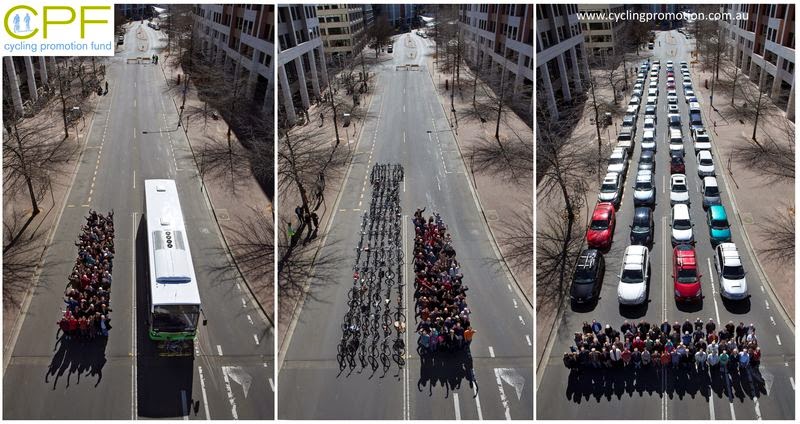
The amount of space required to move the same number of
people by bus, bicycle, and car. Two of
them lead to people getting around; the third leads inexorably to gridlock. As
public transit planning consultant Jarrett Walker wrote,
“the scarcity of space per person is
part of the very definition of a city, as distinct from suburbia or rural area,
so the efficiency with which transport options use that space will always be
the paramount issue.”
In trying to explain why expanding the network of protected
bike lanes won’t work, Milloy writes that “D.C. is not Denmark, San Francisco
is not Sweden, New York is not the Netherlands.
Here, bicycles and cars were not designed to ‘share the road,’ and the
roads weren’t built to accommodate the wishful thinking of well- intentioned
urban planners.” This is where I need to
remind myself that Milloy really isn’t qualified to take this subject on,
because if he knew his shit then he would know that Denmark wasn’t Denmark,
Sweden wasn’t Sweden, and the Netherlands weren’t the Netherlands just a few
decades ago. They tried the same
car-centric model of development we did, and recoiled
in horror at what they found. And
what is this about our roads not being designed for sharing with cars?! DC’s layout was designed in an era when
horses and carriages were the closest thing we had to cars. Am I to understand that L’Enfant and Ellicott
considered the issue of cars vs. bicycles in their designs, and came down
firmly on the side of cars?
The shift towards cars was a distinctly 20th
century movement, and today we’re finally starting to undo it. Many of DC’s bike lanes are unprotected by
barriers and thus made useless by drivers stopping in them, swerving
through them, or just plain driving down them (note: those images are from
the L Street bike lane, which is protected.
You can imagine what it’s like on the others). With more miles of protected bike lanes, more
cyclists on the roads, and better-educated drivers and police, there’s really
nowhere for cycling to go but up. As
bike facilities improve more people start to use them, a trend which dovetails
nicely with a generational
shift against cars which sees millennials turning away from them in favor
of just about anything else.
If I sound like I’m disparaging Milloy’s arguments, it’s
only because of how stupid they are. In
fairness though, I don’t know if it’s even possible to mount a sensible defense
of the role cars occupy in our cities today.
In light of all this, I would like to offer Mr. Milloy an
alternate plan. We’ve already created an
alternate space for cars- the highways, strip malls, and endless exurbs ringing
every American city. Milloy wants
cyclists to board “special buses” to move them around on their arrival to the
city. These buses already exist- they’re
simply called ‘buses,’ and if we truly value our ability to get around this
city we should instead insist that it should be drivers who dismount outside of
the District and proceed into the city on alternative transportation- metro,
buses, a rebuilt streetcar network, or perhaps even bicycles. It’s the only way to avoid the pollution,
dollar cost, gridlock, and deaths that cars inevitably bring along for the
ride.
Monday, December 22, 2014
Andrew Hawkins' Powerful Statement
There has obviously been a lot said on Tamir Rice's murder, but I found this video of Browns player Andrew Hawkins explain his decision to wear a shirt calling for justice extremely smart and inspiring.
Thursday, December 4, 2014
I Can't Breathe
Like Kari said, I'm pretty much at my end on this without more time to reflect, but for now I think looking at Eric Garner's words is pretty important.

Tuesday, November 25, 2014
No Justice for Mike Brown
The government story is this: Mike Brown gets shot, runs 148 feet away, and then decides to kill himself by running into a hail of bullets.
— Shaun King (@ShaunKing) November 25, 2014
Monday, November 10, 2014
Causality/Correlation
These lines from this very good Matt Stoller piece stood out as obvious but also very important and often misunderstood:
The only time the question even comes up now is in an inverted corroded form, when a liberal activist gnashes his or her teeth and wonders — why can’t Democrats run elections around populist themes and policies? This is still the wrong question, because it assumes the wrong causality. Parties don’t poll for good ideas, run races on them, and then govern. They have ideas, poll to find out how to sell those ideas, and run races and recruit candidates based on the polling. It’s ideas first, then the sales pitch. If the sales pitch is bad, it’s often the best of what can be made of an unpopular stew of ideas.
Thursday, October 30, 2014
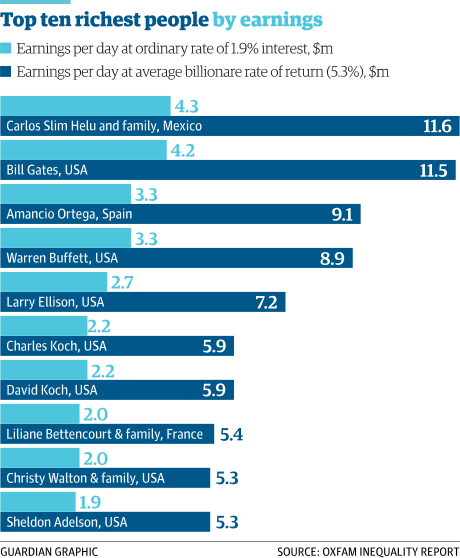
How the Rich Stay Rich
Good stuff in this Guardian piece, but this chart in particular shows how the super rich stay richer: (via this tweet)
Wednesday, October 15, 2014
Romney Unleashed
In a article about Mitt Romney considering another presidential run (lol), I honestly find these quotes at the end kind of incredible:
Romney himself told the New York Times several weeks ago that “circumstances can change.” He also suggested that if he ran again, he would focus on avoiding off-the-cuff remarks, like the notorious “47 percent” line that dogged his campaign in 2012.If Romney thinks he lost because he let down his weird pseudo-human persona to often...
“I was talking to one of my political advisers and I said: ‘If I had to do this again, I’d insist that you literally had a camera on me at all times,” Romney told Leibovich. “I want to be reminded that this is not off the cuff.”
Tuesday, September 30, 2014
Arm Everyone, Let God Sort it Out
CNN BREAKING: Another Iraqi base falls to ISIS: military base 50 miles NW of Baghdad; ISIS has seized a large weapons cache
— Vaughn Sterling (@vplus) September 30, 2014
This does seem to be our basic policy. I find it kind of crazy that the proponents of arming people are never really forced to acknowledge that this isn't like changing money between bank accounts. When you give guns to people in failed states, there is a very good chance those guns will end up in someone else's hands.
Tuesday, September 16, 2014
Selling The War
I'm kind of surprised that more hasn't been made of this:
NEW YORK –- President Barack Obama met with over a dozen prominent columnists and magazine writers Wednesday afternoon before calling for an escalation of the war against the Islamic State, or ISIS, in a primetime address that same night.I understand there is some amount of this stuff going on all the time that we don't hear about, but the formality of it and the number of people seems particularly gross. Not to mention it includes some of the dumbest "journalists" we have out there in David Brooks Tom Friedman and Jeffery Goldberg. But then again, that is the point. You're not inviting people here to question their actions, you're bringing them in so they can help sell your war.
The group, which met in the Roosevelt Room of the White House in an off-the-record session, included New York Times columnists David Brooks, Tom Friedman and Frank Bruni and editorial writer Carol Giacomo; The Washington Post's David Ignatius, Eugene Robinson and Ruth Marcus; The New Yorker's Dexter Filkins and George Packer; The Atlantic's Jeffrey Goldberg and Peter Beinart; The New Republic's Julia Ioffe; Columbia Journalism School Dean Steve Coll; The Wall Street Journal's Jerry Seib; and The Daily Beast's Michael Tomasky, a source familiar with the meeting told The Huffington Post.
National Security Advisor Susan Rice, Deputy National Security Advisor Ben Rhodes and White House Chief of Staff Denis McDonough also attended the meeting, according to the source.
Wednesday, September 10, 2014
The March to War
We've learned so much from the first several wars with Iraq that we're giving it another try. Maybe this time our bombs will give them the freedom and democracy that our previous bombs did not.
Friday, September 5, 2014
Fast Food Strikes Continue to Grow
Going for civil disobedience is an interesting escalation of the campaign:
CHARLESTON, S.C. -- About two dozen of this city's fast-food workers marched Thursday afternoon to a street corner that's home to a McDonald's, a Wendy's and a KFC. Calling for a living wage of $15, they seated themselves in the middle of a freeway entrance, backing up traffic as far as the eye could see.This is obviously difficult to pick out, but it would be interesting to know SEIU's internal info on how many of these strikes have sprung up on their own due to the attention the previous ones received.
Charleston police were eventually forced to pull them out of the street one by one, citing them for disorderly conduct in what were deemed "non-custodial" arrests. All told, 18 people -- most of them earning right around minimum wage -- were arrested next to the McDonald's parking lot.
"I'm just tired of seeing my family struggle," Robert Brown, a 20-year-old with short dreadlocks sprouting from his McDonald's visor, said right after a cop handed him a citation ordering him to appear in court. "I can't help them at all with what I make."
The Charleston arrests were part of Thursday's nationwide protest coordinated by Fight for $15, a union-backed campaign in which workers are demanding a $15 wage and union recognition. With the support of local labor and community groups, workers have been taking part in a series of intermittent one-day strikes in various cities over the past two years, shaming big fast-food companies like McDonald's over low pay and irregular hours.
Organizers billed Thursday's strikes and protests as an escalation of the campaign through civil disobedience. Notably, the demonstrations have spread well beyond big cities like New York and Chicago, where they were originally based. On Thursday, workers took to the streets in places like Durham, North Carolina; Tucson, Arizona; and Rochester, New York, according to news reports.
A Fight for $15 spokesperson said that roughly 500 people had been arrested in the demonstrations as of Thursday afternoon, though a portion of those appeared to be citations without arrest.
In instances that HuffPost could confirm, police arrested 47 people in Kansas City, Missouri; 27 in West Milwaukee, Wisconsin; 19 in New York City's Times Square; 30 in Detroit; 11 in San Diego; 8 in Wilkinsburg, Pennsylvania; seven in Miami; and three in Denver. Police also confirmed 19 citations in Chicago; 10 in Indianapolis; 13 in Hartford, Connecticut; and 10 in Las Vegas. In most cases, the arrests and citations came after protesters were blocking traffic.
Wednesday, August 27, 2014

Monday, August 25, 2014
Fuck Everything
At one point tonight, Michael Brown protesters chanted "hands up, don't shoot!"
Darren Wilson supporters responded: "Shoot! Shoot! Shoot!"
— Wesley Lowery (@WesleyLowery) August 24, 2014
Thursday, August 21, 2014
Killer Mike on Ferguson
Have loved Killer Mike for some time, so glad he got some airtime on CNN. Really smart stuff:
Tuesday, August 19, 2014
Monday, August 11, 2014
Police Shoot Unarmed Black Teen, Part 10,000
Post racial America:
Dorian Johnson told WALB-TV that he and Brown were walking home from a convenience store when a police officer told them to get out of the street and onto the sidewalk. Johnson said they kept walking, which caused the officer to confront them from his car and again after getting out of his car.
Johnson said the officer fired, and he and Brown were scared and ran away.
"He shot again, and once my friend felt that shot, he turned around and put his hands in the air, and he started to get down," Johnson said. "But the officer still approached with his weapon drawn and fired several more shots."
Subscribe to:
Posts (Atom)